 THE PERANAKAN
Baba Ong Jin Teong explores the evolution and varieties of the glutinous rice dumpling or chang.
In this third part, we explore contemporary techniques and methods to deploy in the preparation of chang. Our readers may wish to access Part 1 and Part 2 at these links
1 – Techniques and Methods to Speed Up the Preparation of Chang
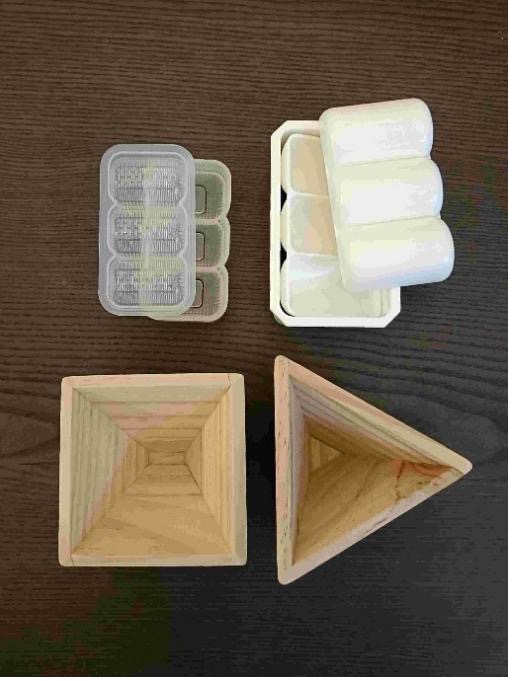
The preparation of chang is a tedious process and there is a need to innovate faster technologies and techniques. Fortunately, there are easily available plastic and wooden moulds which help at least to speed up the wrapping process, without too much practice.
For rempah udang, I spread the steamed glutinous rice on the banana leaves, spread the filling on top and then wrap the rice to cover the filling. During the wrapping process it is important to compress and then to shape the rempah udang into a cylindrical form before finally wrapping it with the same leaf. I find it much easier and faster to use plastic sushi moulds to compress the partially cooked glutinous rice before wrapping it in banana leaves. The shape and size of the rempah udang will then be uniform.

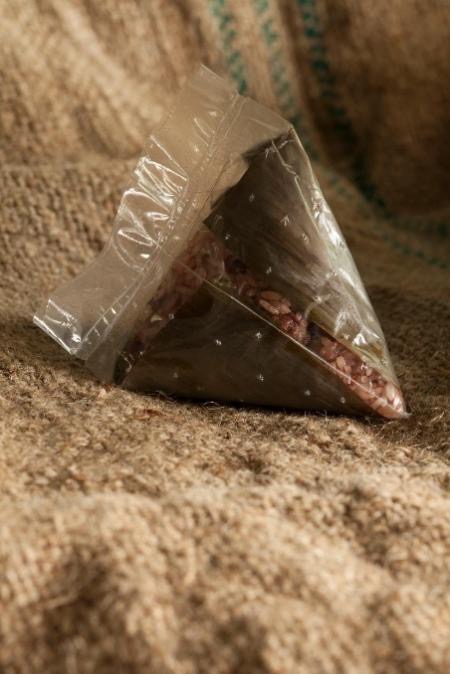
Right: Bak chang wrapped in plastic and sealed
In my younger days in London, bamboo leaves were not available, so we resorted to using the special plastic bags used to keep food in the freezer. Once out of the freezer, the pack can be boiled without having to remove the frozen food from the plastic bag. We used these plastic bags with a plastic sealer to wrap our bak chang into a tetrahedron shape. Since the plastic is impervious, I used a large needle to perforate the sealed chang to allow the water to seep through the holes when the chang is boiled. Today, one can easily line the plastic bag with some bamboo leaf for flavour as well.
There is now an increasing number of multi-food processors that can chop, grind and cook. These can be used in preparing the chang fillings and later to boil or pressure cook the chang. Pressure cooking the chang reduces the time needed considerably.
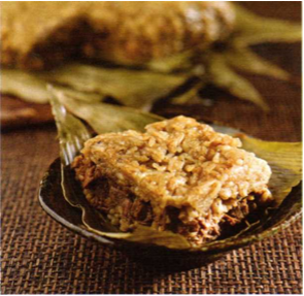
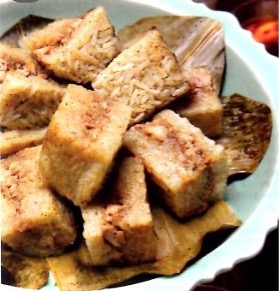
The wrapping process can be bypassed if the glutinous rice is partially cooked and spread out on a tray lined with bamboo or banana leaves. The bak chang filling is then spread over the glutinous rice, followed by another layer of glutinous rice. The filling is thus sandwiched between two layers of glutinous rice. You can increase the amount of filling in your own chang! It is important to compress this ‘sandwich’ chang and cover it with another layer of leaves and further compress it before steaming or baking. I wish to credit Marion Siow for these insights.
2 – Comments and Summary
My research on Chinese zongzi led me to the Japanese chimaki variant. The American version of the zongzi was described as Chinese tamale. I am amazed to learn that tamales are one of the oldest known dishes in the world, with origins dating back to8000 to 5000 BCinMesoamerica (Central America), pre-dating the zongzi. They were a staple food for civilizations like the Olmecs, Maya, Aztecs and Toltecs.
I learnt about the many interesting regional variations of zongzi in China.
I am happy to share my understanding of the various Chinese dialect variations of the chang across Southeast Asia and Japan.
One factor was very clear in my research: zongzi has served as portable nourishment for scholars, warriors, hunters, and travellers all over the world, all the way back to the ancient Aztecs and Maya civilisations.
I came across food additives like slake lime and alkaline water used in preparing zongzi and tamales. Alkaline water should only be used in small quantities to improve the texture of food. Always use food grade lye water as it is not as caustic as the industrial grade lye made of caustic soda, which is more corrosive. Slaked lime, also known as sireh kapur, is mildly alkaline and not corrosive. Some traditional preservatives like boric acid have been banned to avoid indiscriminate use. This is also why TV producers are unduly concerned about adding or mentioning traditional food additives in recipes for general broadcast.
I am glad to note that halal bak chang made with chicken and other meats instead of pork has become popular in recent times in Malaysia, Singapore, Indonesia and Brunei.