 THE PERANAKAN
Nyonya Sharon Wee, a descendant of Gan Eng Seng, recaps a packed yet meaningful time reconnecting with her roots in Fujian, China
Our world today is fraught with fears about the future, immigration, displacement and survival. Perhaps, these explain why there is a global uptick in searching for our roots. Tracing one’s ancestry in China has been on the rise among the Chinese diaspora. I am not sure if Dato Ronald Gan had set the path ablaze or ridden on the trend. Back in November 2023, at the Baba Nyonya Convention in Melaka, I shared with him that my paternal grandmother was surnamed Gan. We soon discovered that we had a common ancestor in Gan Eng Seng, after which Dato Gan expressed his desire to organise a trip to China to visit the Gan ancestral homeland.
That dream materialised this April (2026) when 226 Peranakans from Malaysia, Singapore, Australia, New Zealand and New York (my daughter and me), convened in Xiamen for the “Persatuan Peranakan Baba Nyonya Malaysia Fujian Cultural and Heritage Trail”. Dato Gan, the PPBNM’s president, had made at least seven prior trips to perfect the itinerary, to ensure seamless transfers, comfortable hotel stays, a busy program and food – lots of food!
Our group arrived throughout the day on Saturday April 18 at the Huaqiao Hotel, a state-owned hotel that back in 1986, was where Baba Peter Lee sought accommodation. He was among the first to seek his roots after Singapore and China re-established diplomatic relations. The hotel stands proud despite the onslaught of newer, gleaming luxury hotels that have developed in tandem with Xiamen’s transformation as a Special Economic Zone.
Early registrants gained insight from a morning panel about “Medicinal Diet and Home-Based Health Care”, followed by participants having a rambunctious rumble of “Traditional Fitness in China: Baduanjin”. After lunch, Dato Ronald welcomed us with a rousing speech sprinkled with Baba Malay idioms and wit, exhorting us to be courteous tourists as guests of China. We continued like good students sitting through “Health and Happiness to a Hundred Years” followed by a lecture about the “Traditional Marriage Customs in Minnan” that highlighted similarities between the southern Fujian and Peranakan wedding rites.

There was hardly any time to sneak out to the nearby main commercial thoroughfare, Zhongshan Lu, to stock up on Fujian’s famous teas, jiandui snacks and pineapple cakes. We had to rush back to dress up for the first kebaya formal that evening. It was my daughter’s first attendance to a Peranakan gathering of critical mass. My niece, who had accompanied me to the Phuket convention in 2024, forewarned Lizzie, “Wait till the singer belts out YMCA!”. Indeed, when Baba Daniel Ang from Melaka belted out the Village People song, the atmosphere was laujiat as any true-blue Baba event, complete with conga lines, the twist and line dancing. Yes, the Persatuan made sure to bring on board their band as well as fashion show for this trip! For the most part, I sat there wolfing down the delicious fried mee sua that so reminded me of my childhood when I made annual visits to my parents’ Hokkien friends’ place. The towkay’s wife had whipped up this exact dish, something I have been craving for a long time. Baba Ronney Tan told me to eat less, be a good sport and dance more.
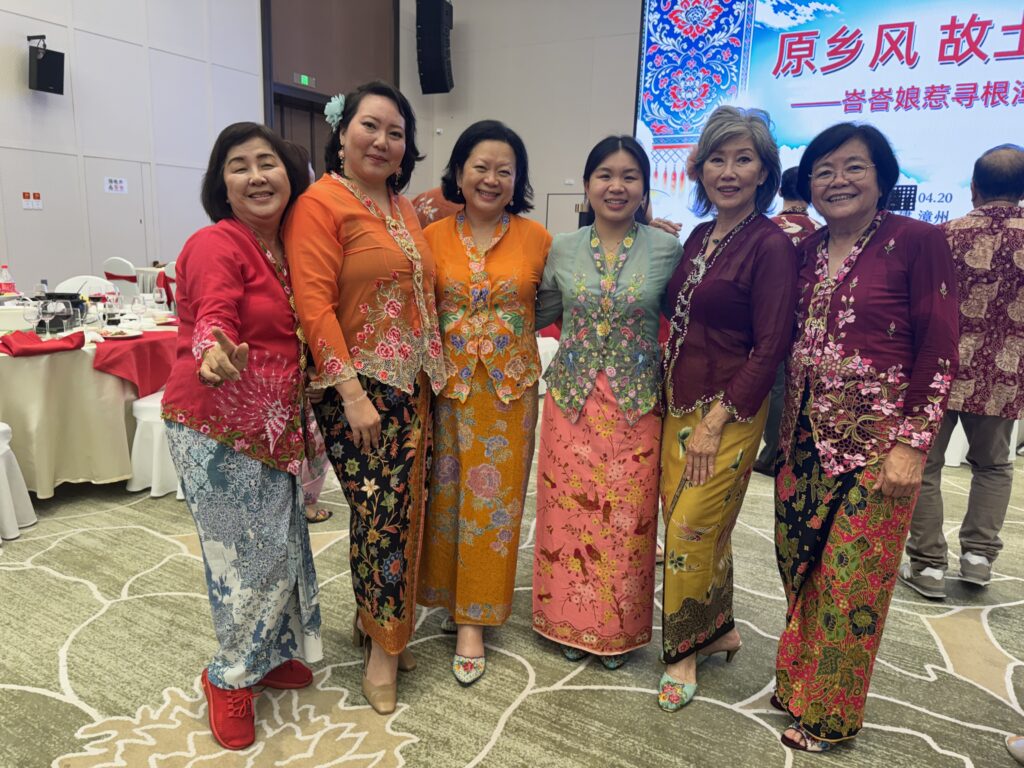
Sunday was a long and productive day where we left Xiamen (an island) and crossed the bridge into Zhangzhou. On the actual mainland, many Peranakan families claim their family lineage from this part of Fujian. Our ancestors left the coastal strip where tall mountains imposed a forbidding barrier from the rest of the hinterland. Looking in the opposite direction, the sea invited greater promise and thus, many left for Southeast Asia and beyond to seek their fortune. Several Peranakan families have managed to trace back their roots to villages in Zhangzhou. In fact, a few, like me, had visited distant relatives and family ancestral halls before the start of this group tour; and a few others were planning to do so afterward.
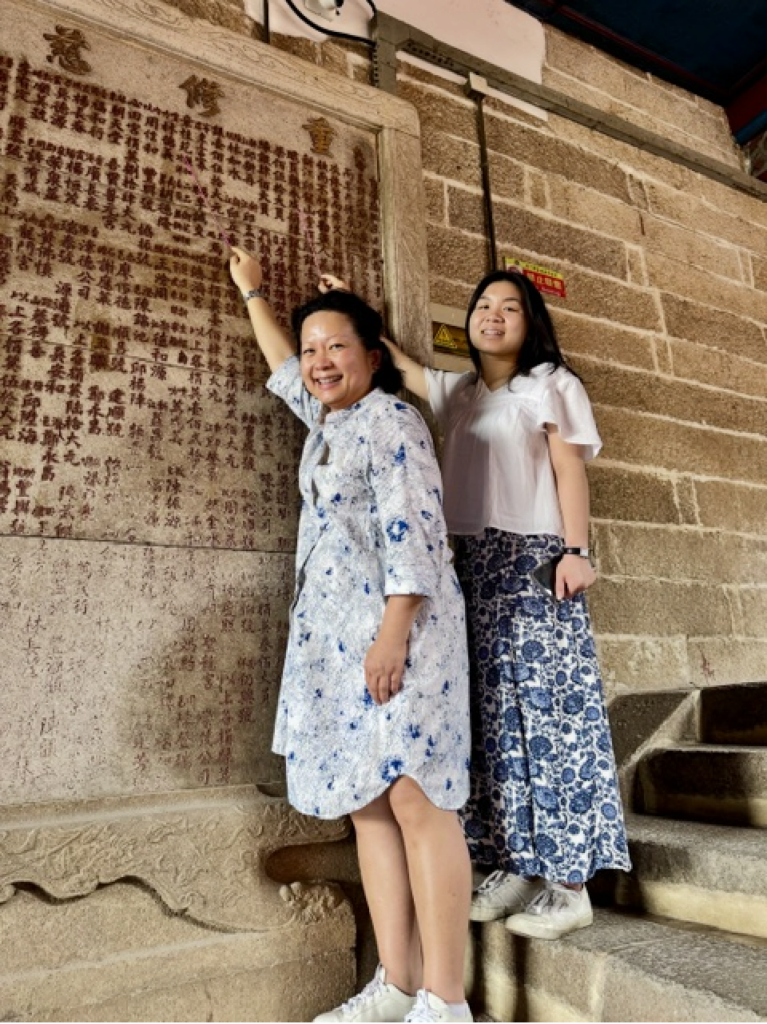
For our tour, we began at Qingjiao Qiji Gong, a 500-year-old hall dedicated to Wu Tao, a sanctified royal physician who had saved the sick and poor. What resonated for our community was the fact that Gan Eng Seng, in 1894, had rallied many of his overseas Chinese peers to contribute to the refurbishment of the temple, first established in the 1100s. In gratitude, their names have been engraved on a stone stele in the hall. We did not have time to explore the Traditional Chinese Medicine Museum or to climb to the top of the stairs where a large statue of the saint stood. I have been told that from that vantage point, one could survey how our forefathers meandered the waters before they sailed to Nanyang.
At Qiji Gong. My daughter and I are pointing to our ancestors’ names on the stone stele to commemorate overseas Chinese from Singapore and Malaysia who donated to the refurbishment in 1894. (left)
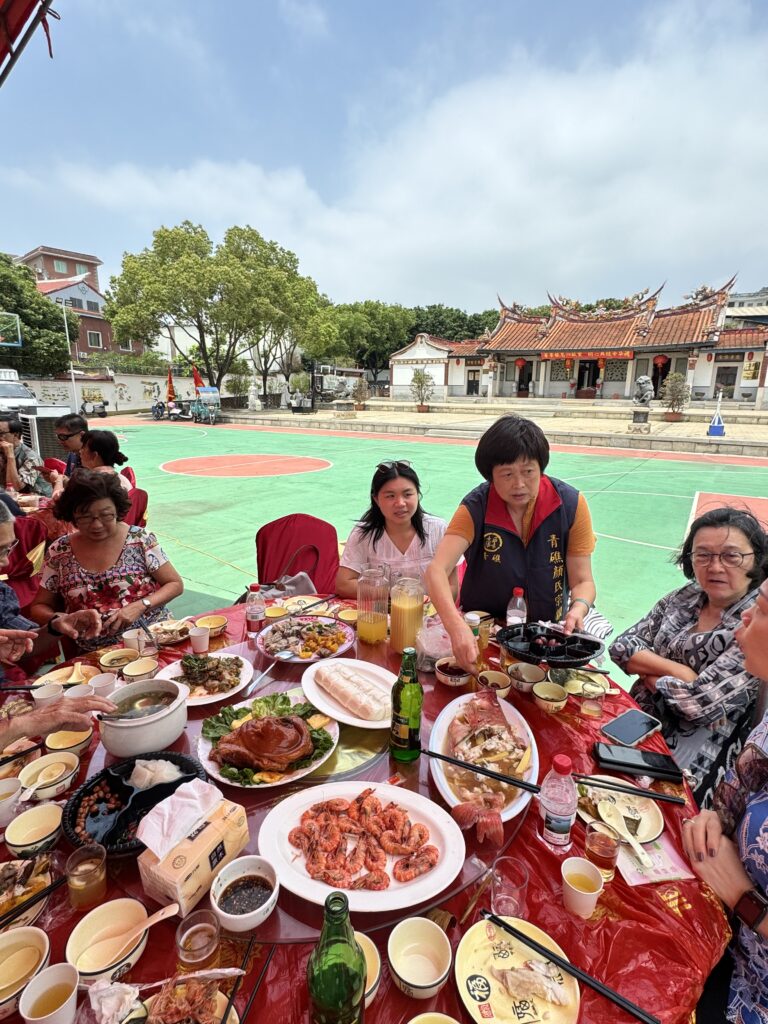
Next stop was the Gan ancestral hall which was not too far away and within the same Haicang District. Dato Ronald rallied his distant Gan relatives to pay respects before the altar, now laden with an offering of fruits, fish and more strikingly for us, the familiar dark green kueh ku. We were fortunate to sample the kueh which were distributed at the start of a full blown 16-course lunch! A basketball court divided the imposing temple hall dotted with cut tile figurines lacing its rooftop, and the red tents and open-air kitchen where we had lunch. We recognised ngoh hiang, oyster omelette oluak, braised pork knuckle in soy sauce along with mantou buns, several kinds of seafood including prawns, a large red snapper, crayfish, crab and a local specialty of pinstriped sandworms in aspic, cut into cubes and served with mustard sauce.
An elaborate 16-course lunch by the Gan Ancestral Hall (right)
The Gan family originated up north in Shandong, and moved down to Qingjiao in Zhangzhou, Fujian during the Song dynasty. From here, the descendants spread to Taiwan and Southeast Asia. It was an illustrious family with several scholars who served as court officials The grand hall we went to only contains some of the ancestral tablets up to the 20th generation since their move to Fujian. All in all, the Gan line is at least 70 generations old since Shandong. Other ‘satellite’ halls came into being as families grew. Gan Eng Seng is from the 27th generation and his branch of the family is venerated in one of these smaller halls.
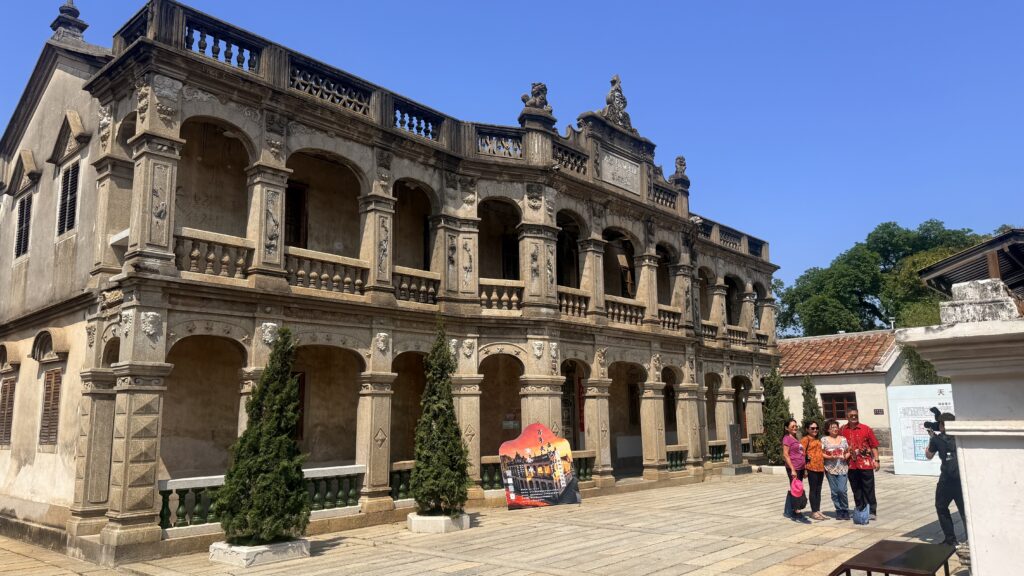
This was only midday of Day Two! We slept off our heavy lunch on the bus and arrived half an hour later at the Tianyi General Bureau post office, known as China’s earliest private international post office where qiaopi remittances were received for the local families who had relatives abroad. The area felt like a sunny but isolated dusty town, with a spot to have coffee. We snooped around the colonial building that stood adjacent to a traditional family home where a central ancestral altar was flanked by side rooms and old photographs.
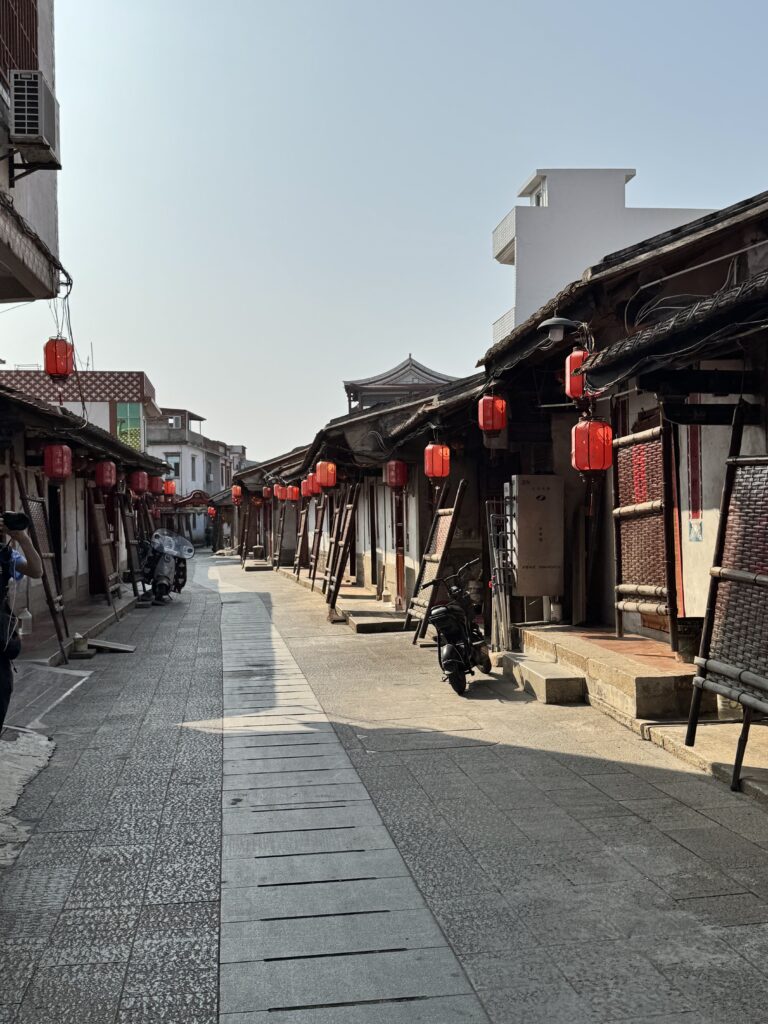
Next stop was Longhai District to visit Yuegang (Moon Port), named in reference to the crescent-shaped waterway that has since dried up, save for tiny crabs burrowing into the ground and being gently teased out by local children. This was once a thriving, privately operated smuggling port that traded with at least 47 countries from as far back as the 1500s. Set along the Maritime Silk Road, it exported silk, porcelain and other goods, proving so lucrative that the emperor legalised the port in 1567 to cash in on the tariffs. The Portuguese were among the first to trade, as evident by the architecture of the thoroughfare lined with squat buildings, just like in old Japan. What resonated for many of us were the wooden screens that shielded the interiors when the main entrance of the house remained open. This was the forerunner of the pintu pagar that grace the front of traditional Peranakan houses, especially in Melaka and Singapore. Our group took a leisurely stroll along the old coast, now simply as narrow as a bicycle pathway, catching the breeze and gentle sunshine, imagining how some of our ancestors might have departed from this very spot if they happened to sail as early as the 16th century, before Xiamen (Amoy) took over as the more significant port in Fujian.
Yuegang Thoroughfare (left)
We ended the long and jam-packed day getting let loose in the old city of Zhangzhou, each of us armed with 50 yuan worth of food coupons to prowl the alleyways in search of makan. With all the loudspeakers, concerts and dizzying lights lining the streets, some of us got lost in the maze. My daughter and I, along with Li Li Chung, pusing sampay mabok and decided to sit down for some soupy desserts that resembled cheng tng and ice kachang, without the ice. Along with a group of GSA members, we truly got lost, unaware that the pickup point had been changed. It was perhaps the most adventurous part of the trip as the three of us were later rescued by the Overseas Chinese liaison officials and swiftly driven back to our next hotel, the Pien Tze Huang Hot Spring Hotel, ahead of our own tour bus! The impressive hotel was monumental in size and outfitted with the most modern amenities in each bedroom, showcasing how China has modernised beyond the days when our earliest Peranakan explorers had to share mosquito-friendly dorms and sleep on squeaky bunk beds before they trekked down to their ancestral village.
Pien Tze Huang is a well-known TCM brand that originated in the late Ming Dynasty when a royal physician concocted a secret formula made with precious herbs, credited with pain relief and treating ailments such as jaundice. (Later on, I discovered that the modern pills contain snake gall!) While most did not have a chance to try the hot springs, several of us managed to squeeze in a massage at the spa which operated round the clock! This proved even more irresistible when we obtained group discounts and our packages included a seven course Japanese meal complete with chawanmushi, salmon sashimi, miso soup, salad, fried rice and even foie gras on toast! Die lah, makan lagi, sampay puas ati!
Just in case I tulis belum habis habis, I will speed up the account of the rest of our trip…
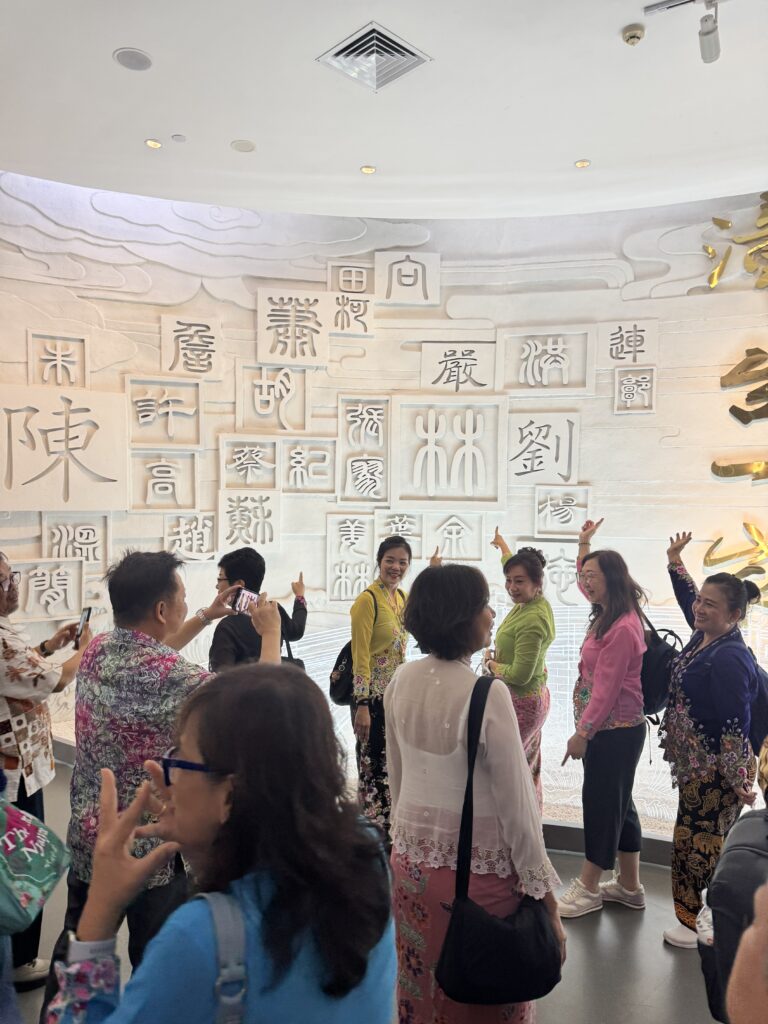
Monday was a more relaxing day where we toured the Zhangzhou Museum located beside the hotel. The massive buildings have garnered an architecture design award and now house several comprehensive galleries that took us through the port city’s history and its ties with the overseas Chinese, in particular, those in Taiwan. In the afternoon, we graced the opening of a photo exhibition titled “Rooted in Tradition, Nostalgic for Homeland: The Zhangzhou Roots of Baba-Nyonya Culture”. We viewed mounted photographs which focused primarily on Melaka, including landmarks such as the Baba Nyonya Heritage Museum on Jalan Tun Tan Cheng Lock; as well as biographies of famous sons such as Tan Tock Seng and Tun Tan Cheng Lock. A section featured side-by-side comparisons of local Zhangzhou food that continue to exist in Singapore and Malaysia, including muah chee, oluak, lou mian (Penang Hokkien mee) minjiang kueh and siguo tang (cheng tng). In turn, satay noodles from Indonesia, along with kueh lapis, keropok and curry rice, have been integrated into the Zhangzhou food culture.
Tracing our surname at the Zhangzhou Museum (right)
We were entertained with a concert put together by the students of the Zhangzhou City University, showcasing wayang opera, guzheng, fashion through China’s dynastic history, and ending with a finale comparing our Peranakan wedding attire against the traditional garb worn by our Chinese relatives dulu kala.
Our gala dinner that evening was a less rowdy event but just as elegant as we put on our second, if not third, set of sarong kebaya and batik shirts. The dancing was more subdued; we were getting quite tired!
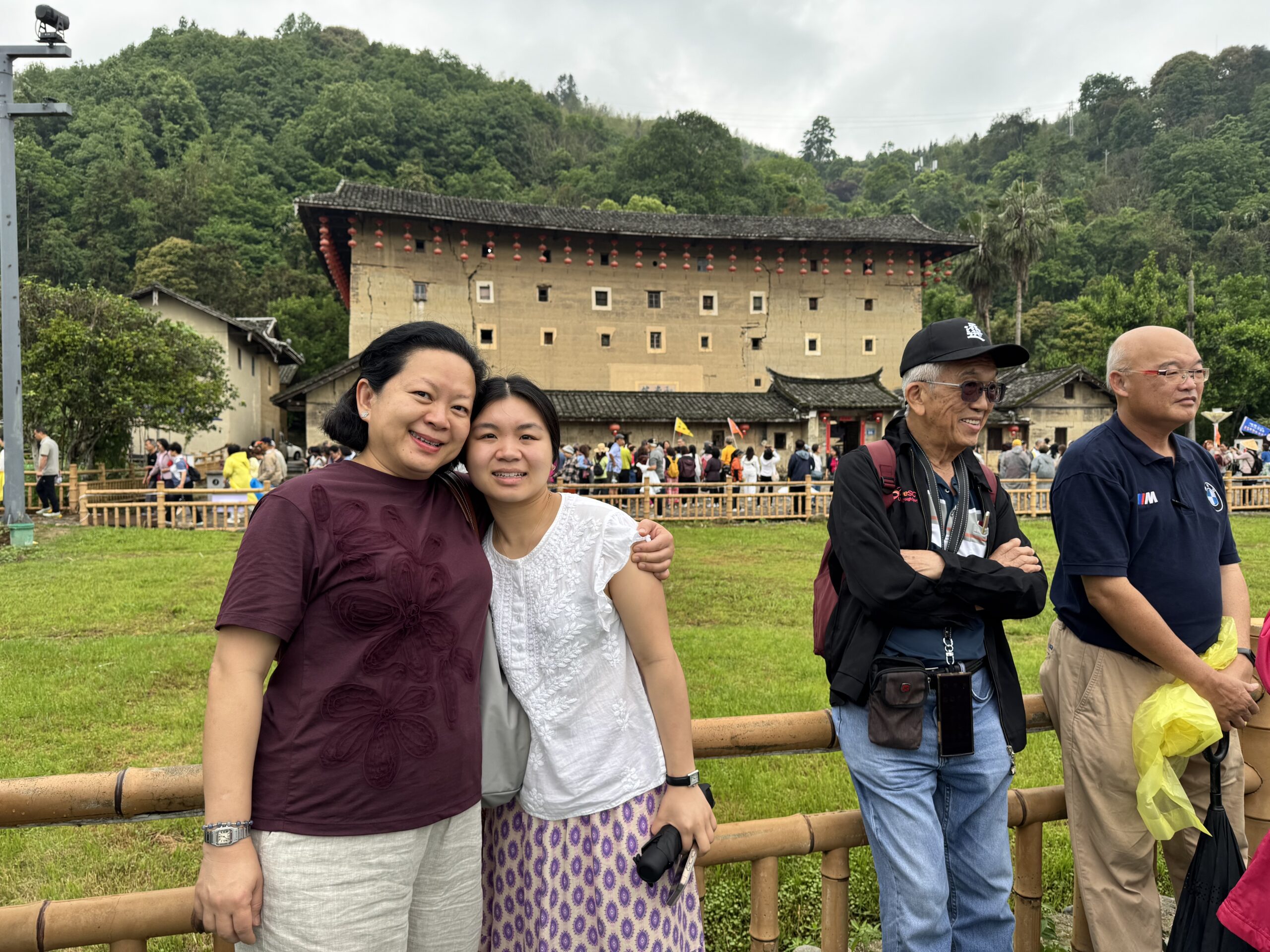
On Tuesday, we travelled past verdant hills and faint mist into the Hakka Village to visit their earthen fortresses known as tulou where each clan practiced communal living. We visited a round tower built in 1905, and a 294-year-old rectangular complex. Each of these had as many as 28 related families within one clan living together. There are practically no windows in the lower kitchen and storage floors to deter marauders, leaving the top floor with portholes pierced through one-metre thick walls, to survey the climate and surroundings. Lunch nearby featured a hearty comfort meal of wine chicken with lots of ginger; tofu, dumplings that reminded me of abacus beads, and preserved kiamchai mustard greens and bamboo shoots to reflect the kind of frugal sustenance typical of the resilient Hakka.
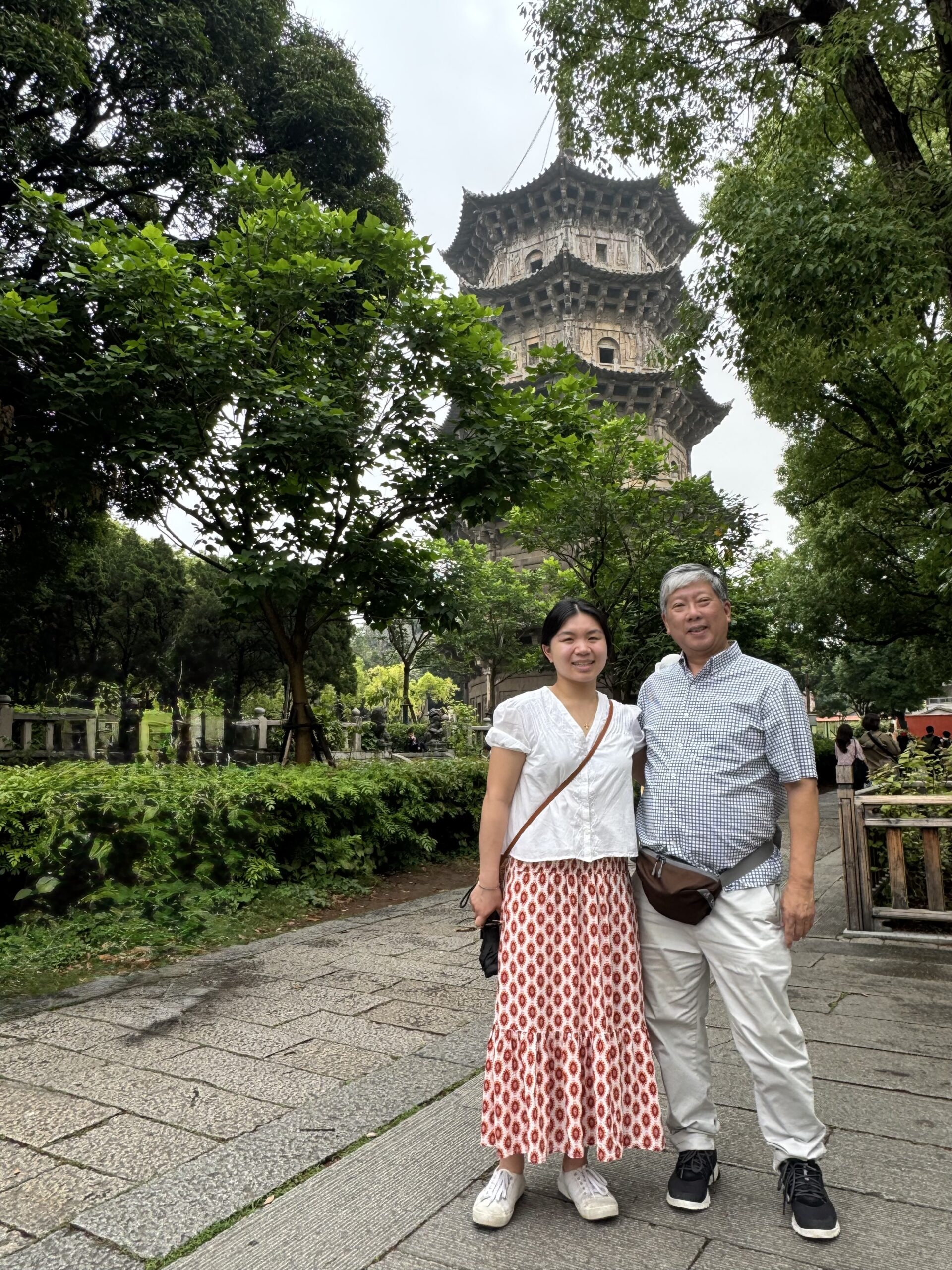
On our final day, Wednesday, we travelled to Quanzhou. Arab traders called it Zaitun, close to the name of the fiery red Tsetung flowers that once carpeted its streets. An earthquake once rocked the city but two hardy pavilions have survived. This, along with the Kaifeng Buddhist temple, were pretty much all that we had time to explore during the 30 minutes allocated. If there was anything I think we could have done more, it would have been to spend a few more hours in this fascinating city. Song Dynasty emperors welcomed traders to this southern port and in turn, encouraged their own to venture forth across the Indian Ocean, from India, Sri Lanka, the Srivijaya kingdom and as far as Africa. Arab Muslims resided and played an important role here, evident by the ancient mosque that still exists, surrounded by what would have been the local Arab neighbourhood. Kublai Khan invited traders to call on Quanzhou, and over time, one such explorer included Marco Polo.
For one thing, the street food seemed so interesting. There were deep-fried slices of sweet potato which was hawked next to goreng pisang. There were lots of boiled meat and tripe, very much like our kway teow um, redolent with a heavy whiff of spices, undoubtedly given Quanzhou’s strategic trading route.
We later adjourned to a delicious lunch that showcased Buddha Jumps Over the Wall, a dizzyingly fragrant soup filled with treasures of the sea that included scallops, sea cucumber, abalone and fish maw, enticing enough for hungry vegetarian monks to scurry over, hence its name. Other treats included the most supple squid in a delightful soy sauce.
Other parts of our itinerary included an endearing puppet show, sales pitches at a large tea shop as well as a TCM showroom. The latter proved to be highly comical as no one could understand the salesman hawking his exorbitant white spheres of medicine which he claimed would prevent heart issues. We resorted to our resident Mandarin speaker, Li Li, as well as Google Translate, to little avail. One curious detour was to a theme village set around a restored mansion built by an overseas Chinese family from the Philippines. Local visitors to the park decked themselves in sarong kebaya as they posed for photographs against the backdrop of the colonial architecture. I think most of us were amused as we watched our heritage be the inspiration for such cosplay, leaving us to ponder if indeed, we had become relics ourselves.
That left me to reflect as we wound down this trip. Our ancestors had left China at least 100, some even more than 200 years ago. Gradually, many of their offspring and later descendants developed a patois, culture and customs that may have diverged, if ever so slightly, from our current distant relatives in China, exacerbated by decades of political changes on both ends – China, Malaya (and then the formation of Singapore and Malaysia).
Most of us, Anglicized, arrived on this trip expressing “Gua tak bacha surat cheena lah” or “Gua tak reti dia chakap apa apa”. Yet, we recognised and gasak the food heartily, feeling very much at home with our soups, mee sua, fried mee, ngoh hiang, bak chang, popiah, tauhu, bamboo shoots, kiam chai, tohay (fermented red yeast rice) and chio cheng. I may be vilified for expressing that we might have even noticed a lot more Chinese influence to our Peranakan food than we let on; that our food is not as heavily Nusantaran influenced as we may think. This is food for thought! Could this extrapolate to the rest of our Peranakan identity?
The group tour ended on a happy, convivial note. For TPAS, we built stronger bridges with our fellow Singaporeans at GSA and our brethren in Malaysia. How could we not, when we choped dinner seats for our bus mates, looked out for one another as we lined up for the loo or walked the winding and sometimes gruelling distances to get to a spot; or bought kana and fruits to share with one another?
Our final dinner at the seafood wholesale market district in Xiamen saw us hugging, young ones and seniors teaching and urging one another to sing, dance or say the right patois phrases to express ourselves. We now cherish the bonds we forged. There was an enveloping camaraderie as we belted out some “anthems”, singing and dancing together: “Burong Kakak Tua”, “Achy Breaky Heart” and most poignant of all, “One Moment in Time”. Perhaps, that last song captures what we truly are, a spot in Camelot in a thousand years of history.
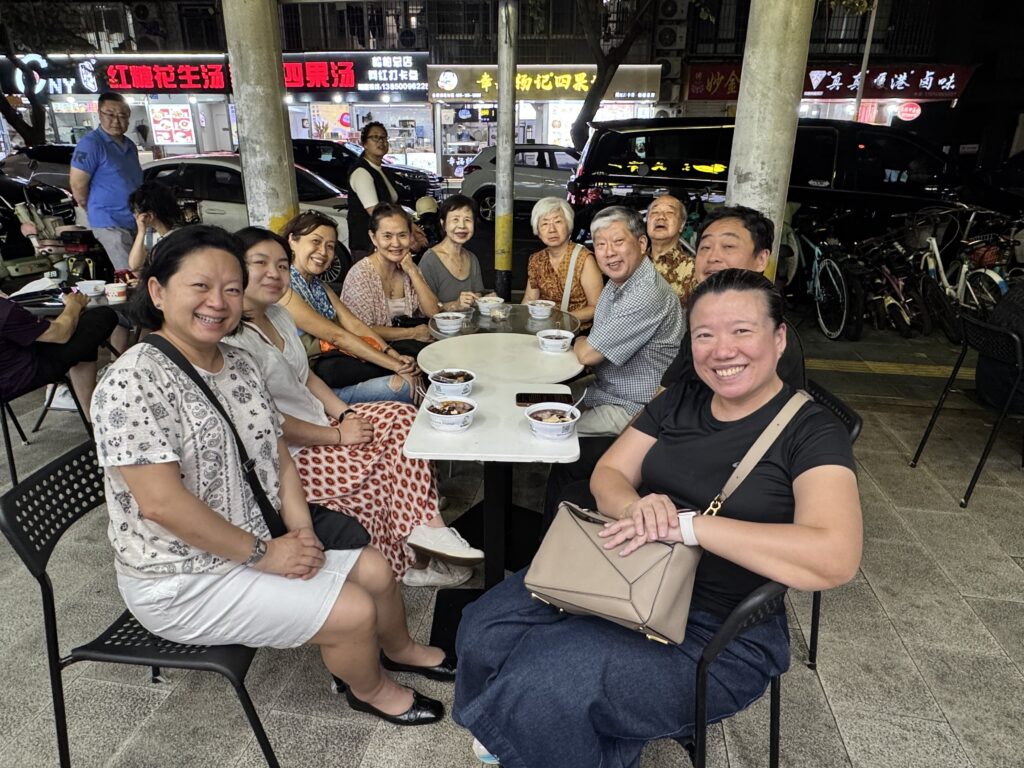
Later that evening, a few of us stepped out for one last midnight shoulder massage; we sat on the sidewalk under the open sky, having dessert while regaling over stories about Klebang, Tranquerah and all the sedara that a few realised they shared. Some others frantically packed all their snacks into large cardboard boxes while a few others had unfinished business and were going on to visit other parts of Fujian over the coming week.
Tracing our ancestry was no longer the main agenda for this trip. Navel-gazing we were not. Mindful at the start not to flaunt our supposed superiority, we sensed the limitations of our language and comprehension that may have challenged and isolated us at times. Yet, we discovered our cultural heritage. We found kinship old and new. Even if we might not have understood all there was to read or listen to, we could giggle, joke and share an anecdote or two. Because, when we put a few Peranakans together, we know how to enjoy each moment. At the same time, we absorbed the sense of history, witnessed the country’s rapid change and understood the background to our story. Our ancestors had leveraged opportunities abroad and thus, we came about as a result. This eye-opening trip was a discovery, and coming ‘home’ made it all so worthwhile.
We departed with a deeper awareness of how migration, memory and adaptation had shaped the people we had become.
The photos in this article were contributed by Nyonya Sharon Wee, Baba Ronney Tan, other delegates, and extracted from the itinerary furnished by the TPAS organising committee.