 THE PERANAKAN
Nyonya Juliana Lim recalls how she rescued two paintings from Panglima Prang, the ancestral home of Tan Kim Seng, right before it was demolished.
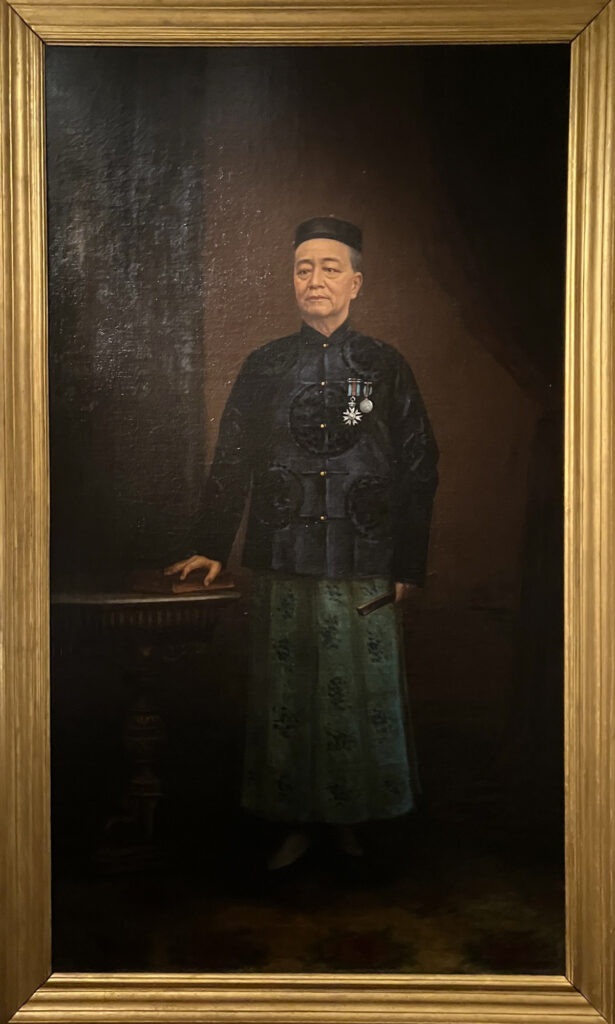
Touring visitors around the Peranakan Museum since my graduation as a docent in March 2025, I cannot resist, on entering the gallery housing artefacts from Panglima Prang, shyly slipping in that I had played a role in rescuing the impressive nine-foot-high portrait of the illustrious Straits-Chinese pioneer Tan Jiak Kim.
Who was Tan Jiak Kim?
As my tour script typically goes, “Tan Jiak Kim (1859-1917) was a 5th generation Straits-Chinese gentleman, the grandson of wealthy Malaccan-born businessman and entrepreneur Tan Kim Seng (1805-1864) who in in the mid-1800s, was far-sighted enough to advocate a fresh-water supply for Singapore. Like his grandfather, Jiak Kim was a successful merchant on top of which he earned a seat in the Straits Legislative Council where he served several terms, retiring in 1916 due to ill health.
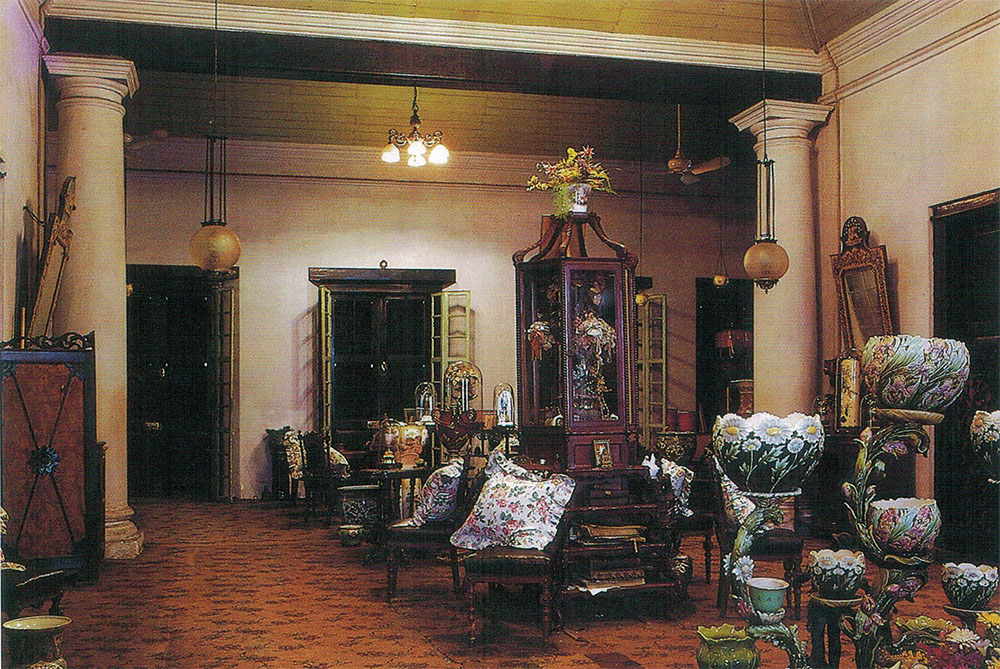
The British admired Jiak Kim for being “broadminded enough to grasp the Western point of view and to weld it easily and smoothly with the Eastern point of view.” In this portrait, the artist aptly captures his dual personality well, a Chinese man in Manchu suit on which is pinned two colonial medals – the first being the Medal of the Most Distinguished Order of St Michael and St George which was awarded to him in 1912; and the other, a commemorative medal for guests at the coronation of St George V in 1911. The artist omitted his cue which his descendant tells me he clung to for as long as he could both because he was proud to be Chinese plus the cue facilitated his travels in and out of China. The silver service Jiak Kim personally assembled for food offerings on the Panglima Prang ancestral altar included receptacles for ice-cream, the favourite dessert of the affluent at the turn of the 20st century, is another manifestation of how he straddled the Eastern and Western worlds.

In 1900, Jiak Kim founded the Straits-Chinese British Association (precursor of The Peranakan Association of Singapore) which I think was his way to voice the emerging identity of Western-educated Chinese of mixed ancestry. He also supported the education of women by making contributions to Singapore Chinese Girls’ School. The Tan family is memorialised in the names of roads like Kim Seng Road, Kim Seng Bridge, Jiak Kim Road and Jiak Kim Bridge.”
How I came to rescue Jiak Kim’s portrait
In 1982, I was working in the Ministry of Culture at City Hall. One morning, I received a call from a property development company. “We are about to demolish an old house near Hotel Morningside on River Valley Road”, the caller said, “Might the Ministry be interested in large paintings hanging on its walls?
‘“Yes, we are interested”, I replied, excitedly, although I had no idea at the time, what the subjects of the paintings were. Our National Museum had such a pitifully tiny acquisition budget ($100,000!) that I was certain we would have use for these abandoned paintings.
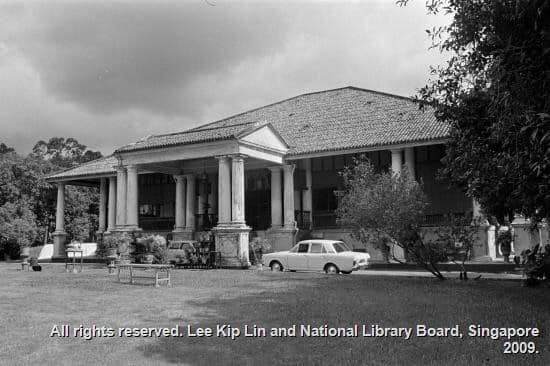
That afternoon, Mrs Eng Seok Chee (Curator / Ethnology, National Museum), Mrs Lim Chong Quek (Conservator, National Museum) and I raced down to the mystery house in my metallic blue Toyota Corolla car. Guided by my road directory, we drove gingerly through a narrow tree-lined road (which now I know to be Jalan Kuala) to come upon a derelict building, already stripped by eager dealers who left a mess of unwanted items including broken green balustrades. Shaded by trees, the rooms were dimly lit. The electrical supply had already been turned off. On the walls, we saw several paintings including a gigantic oil painting of a handsome gentleman in Chinese attire, standing, right hand resting on a book on a round table and left hand holding a fan, both symbols of scholarship. Mrs Eng instantly recognised him as Singapore pioneer Tan Jiak Kim. There was another oil painting of a seated bald man in a Chinese tunic who she thought was Tan Kim Seng. Profusely thanking the representative of the property development company for their gifts, my two colleagues took possession of the two paintings in the days ensuing, for conservation and eventual exhibition.
When we publicised our finds, I received another call from a stranger who said his brother, Low Kway Soo, had painted the portrait of Tan Jiak Kim. At a meeting held at the National Museum Art Gallery Boardroom on the second level of its wing on Fort Canning Rise, we met a sprightly 80-year-old gentleman – Low Kway Song! While he is dressed in Western suit in the Peranakan Museum display, the man I met was dressed in a Chinese tunic and loose trousers. The jolly man danced and smiled joyfully during the tea session, gushing about Peranakan minstrels like the Merrilads, the first time I had heard of them. Mr Low excitedly told us that it was his late elder brother, Low Kway Soo, who painted the Tan Jiak Kim portrait. However, he was too modest to say he had painted the other portrait which turned out not to be a portrait of Tan Kim Seng but of his son, Tan Beng Swee.
Years later, I now know who Tan Jiak Kim was, that the house named Panglima Prang (meaning War Admiral as a soldier was buried on its grounds) was the ancestral home of Tan Kim Seng and his descendants. I also know that the portrait I rescued was not the one painted by Low Kway Soo in 1919. The one I rescued was painted by an artist named Soo Pun Ting (signed “CAS Punting”), and is believed to be the prototype for Low’s painting which was commissioned by the Chinese community for presentation to the Colonial Government for exhibition at Victoria Memorial Hall. Low’s painting hung at the National Museum while Soo’s hangs at the Peranakan Museum. In both portraits, Tan is dressed in black and green Chinese gown and skullcap, holding a fan in his left hand. The differences between the two portraits are that in Low’s portrait, Jiak Kim looks to his left as if into the distant future and his right hand rests on the table, minus the book that Soo included. The setting in Low’s portrait is more elaborate, with Tan “backed” by European-style columns while a large vase of flowers on the table scents the room.
At the point of my career when I rescued the paintings, my portfolio included the promotion of visual arts. While we celebrated the Nanyang Artists of the 1930s, I had never heard of the Low brothers. The discovery of the paintings opened my eyes to the fact that there were reputable Singapore painters prior to the 1930s and the establishment of the Nanyang Academy of Fine Arts. Thanks to art historians and curators like Low Sze Wee and Teo Han Wue, Peranakan artists including the Low brothers have now found their rightful place in the history of Singapore art, alongside our Nanyang artists, in the website of the Peranakan Association, the collections of the National Gallery and Peranakan Museum.
In October 2019, I had the pleasure of meeting Arthur Low, grandson of Low Kway Song, during a National Gallery Singapore dialogue session about the Low brothers. Arthur shared more about the life and accomplishments of the Low brothers. He also revealed that his grandfather was a talented show producer, playwright, set designer and illustrator. He also founded a Methodist Church in Malacca where he conducted services in the Peranakan patois. Despite his duties as a pastor, he continued to paint Sultans, colonial officers and prominent Chinese businessmen. It was a wonderful blast from the past! I was so thrilled when Arthur presented me with a limited-edition religious picture by his grandfather.
About the Author
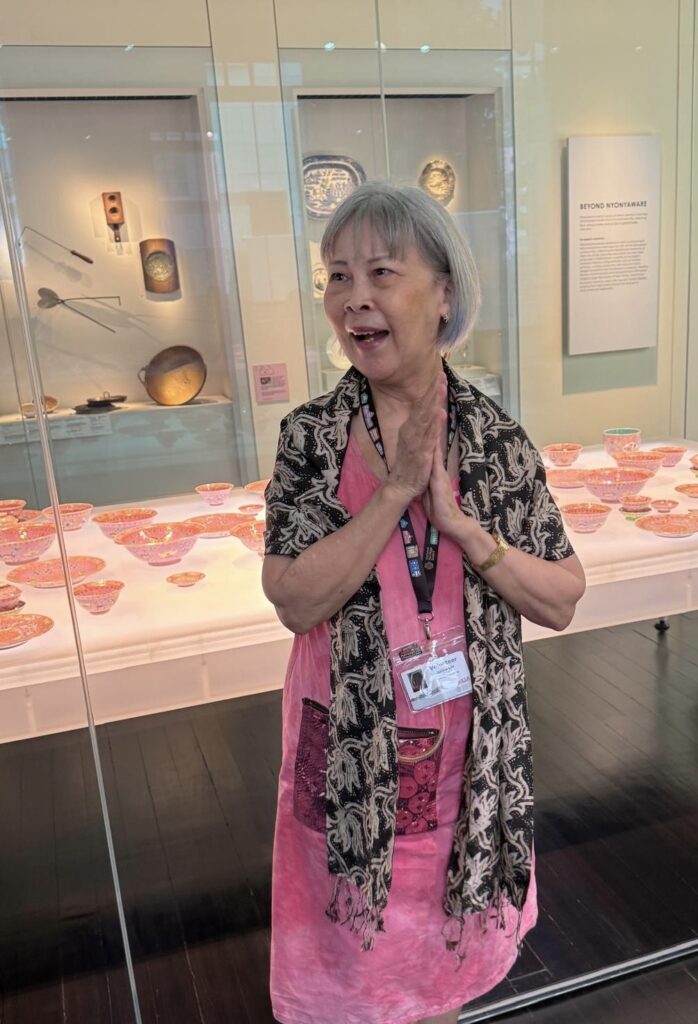
Juliana Lim spent 18 years in the arts management sector and now volunteers as a docent with The Peranakan Museum.