 THE PERANAKAN
Food Writer Peter Yeoh, of the Michelin Guide for Penang and Kuala Lumpur, explores the origins of sambal
A nyonya meal is never complete without sambal. This indomitable chilli-based condiment is ever-present whenever the Babas and Nyonyas eat, be it a family dinner, dining with friends, or a celebratory birthday or wedding feast. A dollop of sambal perks up the mildest plate of fried mee nyonya, adds a depth of flavour to a bowl of pong tauhu or hee peow soups, and cuts through the richness of nyonya laksa.
The mee siam reaches out to the sambal to provide a ballast for its spicy-sour-sweet gravy.
A good sambal, served on the side, can restore vibrancy to a pot of chap chye; leftovers are given a second life, but one which can taste better than its unconsumed progenitors!
So how did chili, a New World crop, become so indispensable to our peranakan culinary culture? To understand this, we need to journey five centuries back into the history of our region.

How Chillis Ended Up Here
For more than a millennium, the Spice Trade wove its way through the Nusantara. Seaborne traders brought nutmeg, mace, cassia bark, cinnamon, and much more from the fabled Spice Islands to Malacca, where Arab and Indian traders came to barter for them. Then, they sailed back home with their precious cargo, to the Red Sea ports where the spices were loaded onto caravans that transported them through the desert sands and mountains before they reached the great metropoles of Turkey and Europe. By then, a handful of spice would have seen its worth multiply to equal its weight in gold.
Alas, this age-old arrangement all came to an end when Constantinople fell to the Ottoman Turks in 1453. Faced with a hostile enemy, the Europeans had to look for an alternative route to the Spice Islands – then the only place in the world where nutmeg, mace, and clove were found.
Portuguese adventurer, Bartholomew Diaz, led the way – rounding the Cape of Good Hope in 1488. By 1510, the Portuguese set up their first colony in Goa. A year later, they took over Malacca.
The Portuguese brought with them their traders, their missionaries, and a whole host of New World foodstuffs, brought back by Christopher Columbus’ expeditions to the Americas from 1492 onwards: corn, potato, tomato and … chilis. The world’s dietary patterns and culinary cultures were about to undergo a very drastic change.
First in Goa, and then in Malacca, the local populace welcomed the chili with an enthusiasm far surpassing the earlier reception it got back in Portugal and Europe.
Implements Used on Chillis
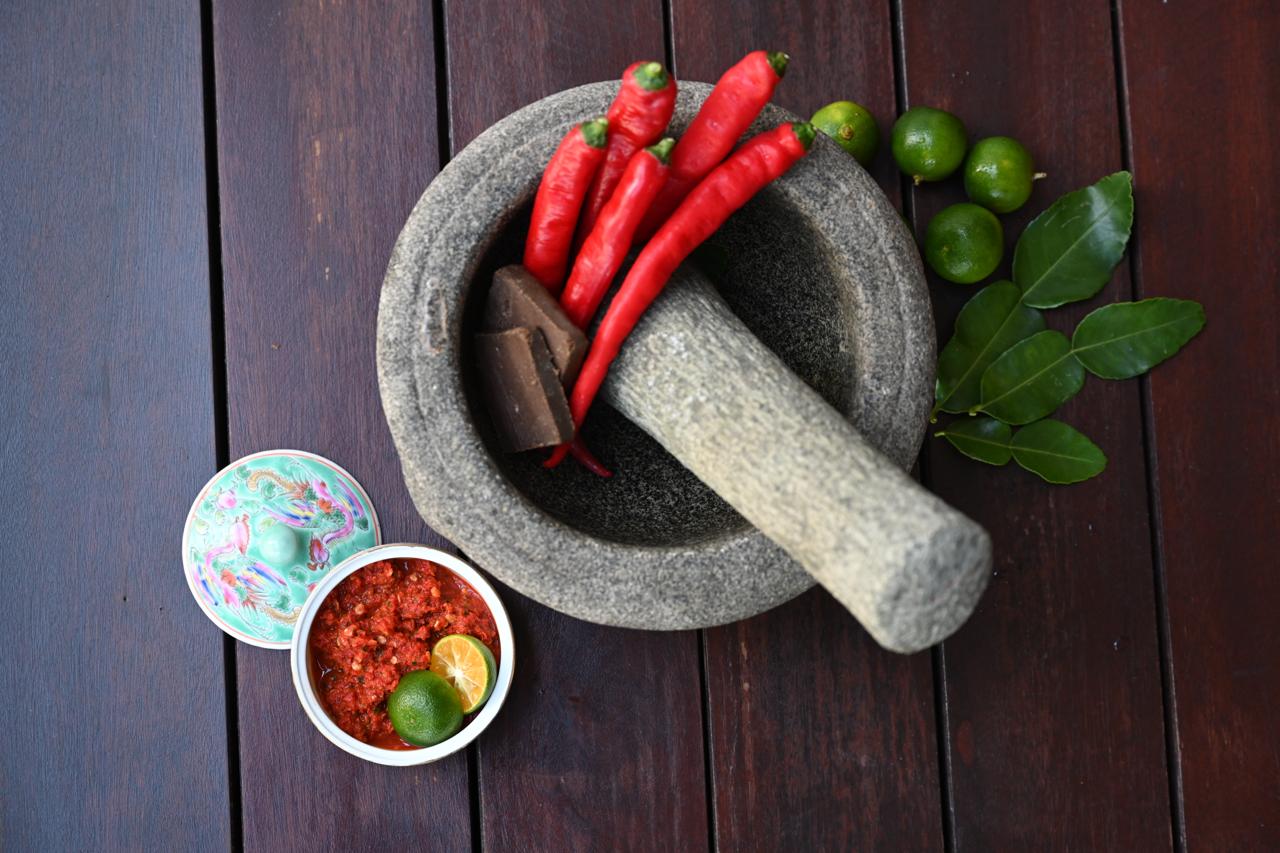
Together with chilis came the implements needed to ground them. The Mexican molcajete (mortar and pestle) became the batu lesong in Malacca, whereas the Mexican metate was replicated as the batu giling: a flat granite slab with an accompanying cylindrical rolling pin. Chilis are ground by sliding the rolling pin to and fro, grinding the chilis in-between the rough surfaces of the slab and the rolling pin.
Today, one cannot envisage our nyonya cuisine without the requisite sambal belacan. The sound of rhythmic pounding of chilis and its accompanying ingredients in a nyonya home is a harbinger of a wonderful meal to come. It heightens one’s anticipation of a meal.
Sambal belacan is constituted of only three basic ingredients: fresh red chilis, toasted belacan (fermented shrimp paste), and a squeeze of calamansi lime. Yet, its attraction far surpasses the sum of its parts.
Submitted by Baba Colin Chee