 THE PERANAKAN
Baba Peter Lee espouses on the origins of buah keluak
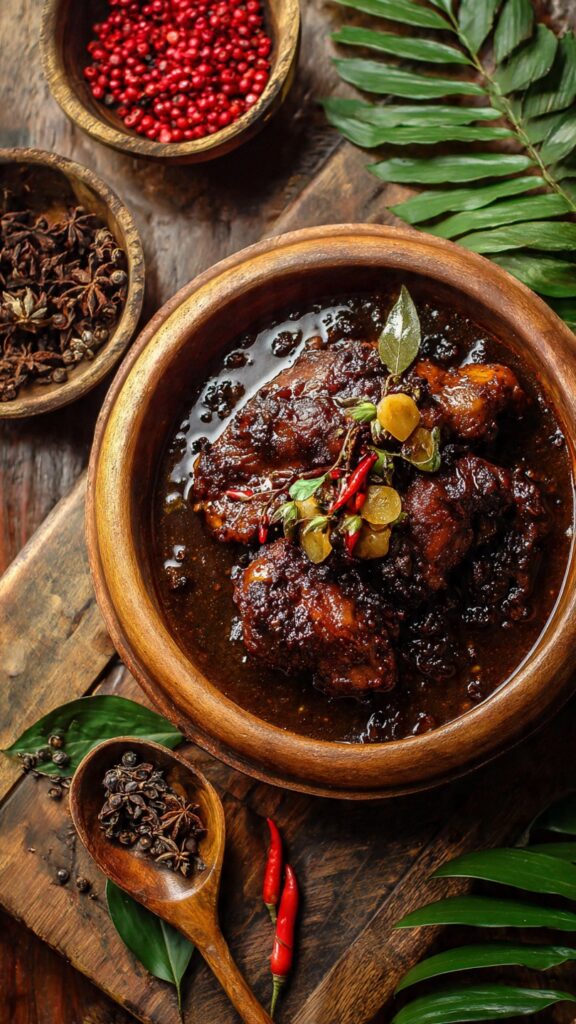
I read with great pleasure and fascination all the articles in “Makan Sampay Pengsan, Makan Sampay Mabok” (The Peranakan, issue 2, 2022).
I particularly enjoyed “From Java with Love: the Origin of the Keluak” by Khir Johari, and would like to share a few reactions to it if I may.
In it, the author draws connections between the Peranakan ayam buah keluak and the Javanese rawon, a braised beef dish with buah keluak, and traces the term rawon to a 12th century Javanese kakawin (narrative poem), Bhomakarya. The correct name of this text, however, is Bhomakawya (also known as the Bhomantaka). This misspelling is often seen on the internet and cookbooks such as Professor Paul Freedman’s Culture, Cuisine, Cooking: an East Java Peranakan Memoir (2015).
The Bhomakawya actually makes no mention of buah keluak as an ingredient of rawon, as Father P.J. Zoetmulder’s Old Javanese dictionary describes it simply as a meat dish. The rawon of that era may in fact be more akin to the version from Bali, where many archaic Javanese traditions have survived, which is prepared with pork or mutton, and does not have buah keluak in it. The Hindu Balinese do not consume beef and it must be pointed out that the narrative of the Bhomakawya is derived from the ancient Hindu Bhagavad Purana, about the demon Bhoma (Bhaumasura), and his battle against Lord Kresna (Krishna). Hence not only would it have been unlikely that the rarawwan mentioned in the Old Javanese Hindu text would have had any buah keluak, it would not have had any beef in it as well. Interestingly the Kitab Masak Masakan India (The Indies Cookbook) published in 1845 in Batavia (Jakarta), has two recipes for rarawon, one with beef, but neither with buah keluak, which would seem to suggest Father Zoetmulder’s simpler archaic version survived in Java well into the 19th century.

It may seem surprising, but rawon is not mentioned at all in the later Serat Centhini, a text composed in Central Java between 1814 and 1823. Although this twelve-volume saga concerns a tale set in the early Mataram period, its fascinating record of Javanese dishes reflect the culinary tastes of the kingdom at the time it was written. Although rawon is left out in the wide array of delectable concoctions described, what appears with some frequency is sambel keluwak (sambal keluak) The Peranakans of course, also prepare this dish, and it might therefore have been the ancestor of ayam buah keluak, rather than rawon. The Serat Centhini also mentions another Javanese classic, nasi ambeng, a dish that created such an online ruckus recently, but that is another story.
Peranakans are deeply connected to Java. Nineteen years ago, when I was the editor of this magazine, a special issue was devoted to our Javanese roots (“Java Jive: a Peranakan Tribute to Indonesia”, The Peranakan, October-December 2004). These connections are not only commercial and cultural, but also familial, and date back to at least the 18th century. The use of the ng prefix for kinship titles, as in ng chek (paternal uncle) and ng chim (paternal aunt), is associated with Javanese custom. Lee Kuan Yew’s grandmother Ko Liem Nio hailed from Semarang, and the grandfather of Malacca tycoon Chee Yam Chuan (1818-1862) had a concubine by the name of Tan Cirebon (suggesting she was a native of the port on Java’s north coast). The family that started Yeo Hong Seng, a batik business in Arab Street in the 1910s, moved to Singapore from Juana, another Javanese port town. Historians and some people outside our community have the mistaken notion that we have appropriated cultural elements from elsewhere. But how do you appropriate something that is an intrinsic part of your cultural and genetic makeup? Peranakans, like so many other peoples in Singapore and the rest of the Malay archipelago, have drawn influences from around the world, and are the descendants of interracial marriages. I therefore heartily agree with Khir Johari that it is all about shared heritage, but let us not forget, it is also shared DNA. I hope in the future this is something we continue to celebrate, and we should avoid at all costs the assertion of impassable boundaries.
As I love saying, all cultures are mixed up.
The writer thanks Professor Emeritus Hedi Hinzler and GT Lye for their kind guidance.