 THE PERANAKAN
Nyonya Diane Chee gains insights on Peranakan Chinese womanhood and interestingly, divorce, in 19th century Java.
Last year, the Peranakan Museum (TPM) acquired a hand-coloured photograph from circa 1900 of a Peranakan Chinese woman wearing a silk damask skirt and blouse with elaborate gold embroidery. Little was known of the subject except her name, Lie Pa-toe Nio, and the fact that she was from a prominent Peranakan Chinese family in Batavia. In researching the woman in the portrait, her family and community, a journey of discovery followed for both myself and Dr Seng Guo Quan, Assistant Professor, History at the National University of Singapore.
At an ACMtalks lecture in August 2021 hosted by the Asian Civilisations Museum and supported by the Kris Foundation, Dr Seng presented a fascinating insight into Lie Pa-toe Nio’s family and the nature of Peranakan Chinese womanhood in late 19th century Java.
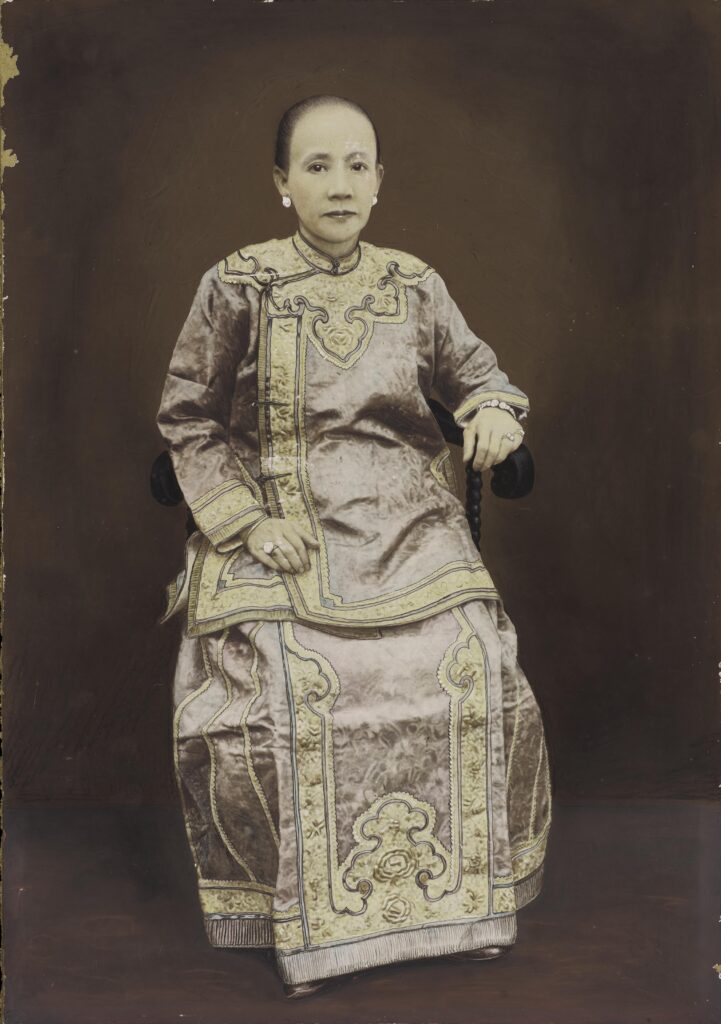
Lie Pa-toe Nio was the descendant of three generations of Chinese officers.
Batavia, circa 1900.
Hand coloured photograph
By accessing the Kong Koan Papers from the Chinese Council of Batavia, now held at Leiden University in the Netherlands, he was able to establish that Lie Patoe Nio was the descendant of three generations of Chinese officers. Her father was Lie Tjoe Hong, 3rd Majoor der Chinezen Batavia, who held the most senior Chinese position in the colonial civil bureaucracy of the Dutch East Indies. An 1884 marriage registration from the same archive documented her marriage to Gouw Kiang Djian, himself descended from a family of Chinese officers.
Using information from divorce trial records also maintained by the Chinese Council of Batavia, Dr Seng discussed the expectations the Peranakan Chinese women had of their husbands and revealed the measure of autonomy that they had over their marriages. Divorce was by and large accepted in 19th century colonial Java, with 60 to 80% of divorce suits filed by women. Interestingly, middle-class Peranakan women were less likely to tolerate polygamy and more likely to initiate divorce, while women like Pa-toe Nio were very unlikely to divorce, despite their husbands being more likely to foster concubines.
Woman’s blouse and skirt
Java, late 19th or early 20th century
Velvet, gold embroidery
Gift of Agnes Tan Kim Lwi in memory of Tun Tan Cheng Lock
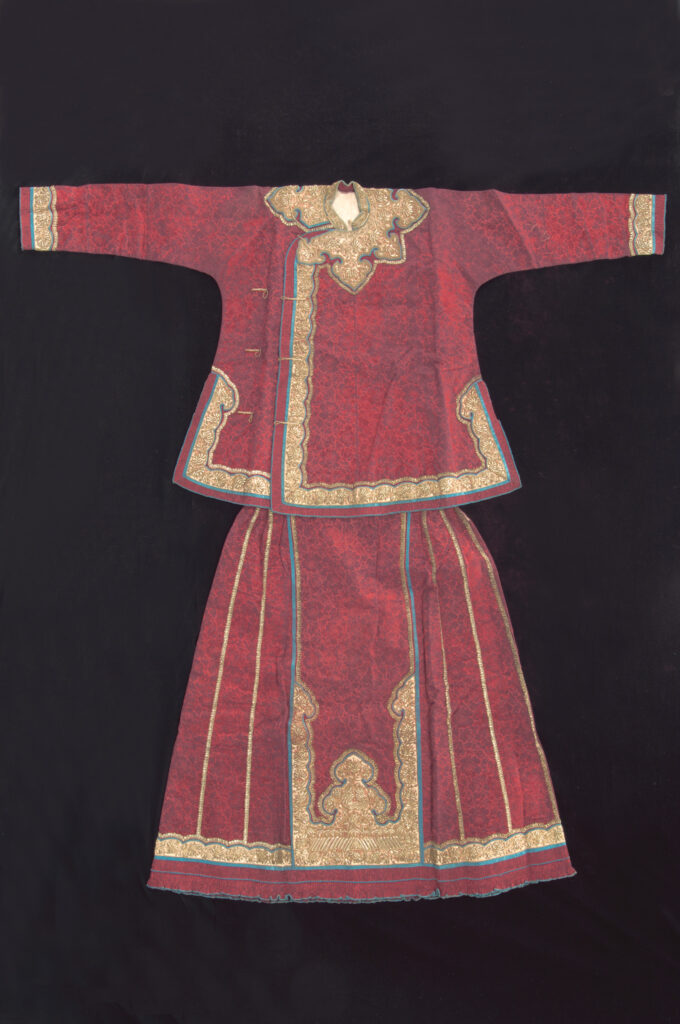
The acquisition of this ancestral portrait is part of TPM’s mission to explore the diverse Peranakan communities of Southeast Asia. The portrait joins TPM’s collection of artefacts illustrating the rich material culture of the Peranakan Chinese communities of Dutch colonial Indonesia. During the same lecture I highlighted examples including a red velvet blouse and skirt that are strikingly similar to the outfit worn by Pa-toe Nio; a pair of embroidered boots that would have been worn at the turn of the 20th century by Peranakan Chinese women in Java on formal occasions; and a rare wooden carriage likely used for a ceremony known as Tedun marking a child’s first year (or first steps).
This portrait, along with the boots and the carriage, will be displayed in the new TPM permanent galleries. We hope that you will come to see them when the museum re-opens in early 2023. Until then, they are available to view on the National Heritage Board’s Roots.sg website.
Nyonya Diane Chee is assistant curator of The Peranakan Museum.
This was previously published in The Peranakan in 2022.