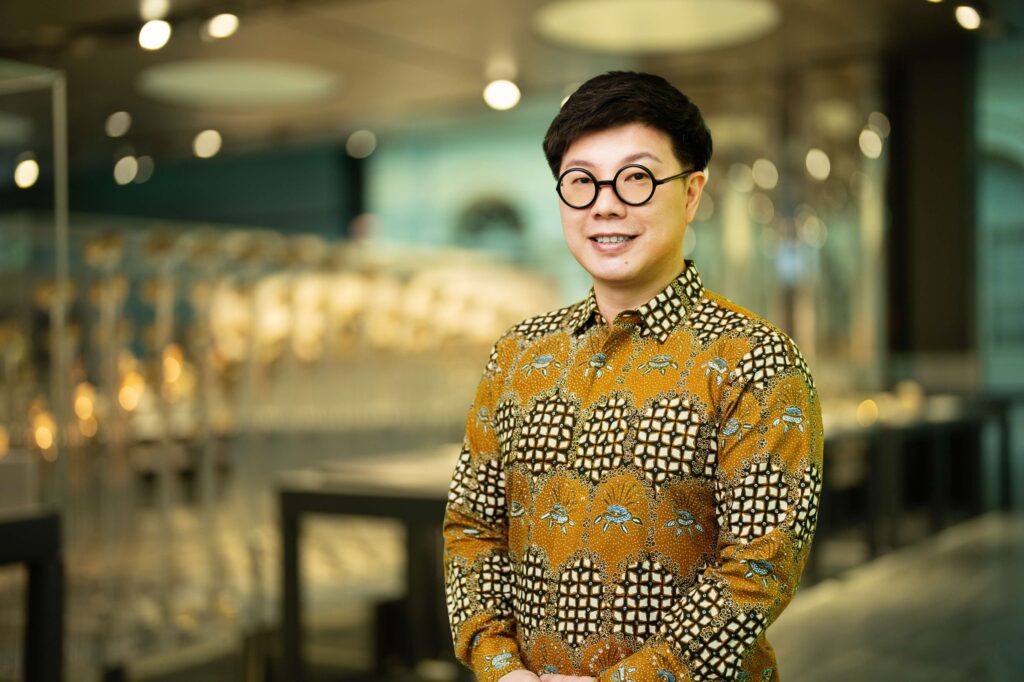
 Emeric Lau
Our association cherishes the collaborative spirit that we have built with the National Heritage Board, specifically Asian Civilisations Museum and Peranakan Museum. We are grateful to Mr Clement Onn for generously sharing his views in the interview below.
Emeric Lau (EL): Trade is a hot-button issue across the globe. What lessons can we learn from studying the trade networks of the past? How do our museums underscore such knowledge and ensure contemporary relevance?
Clement Onn (CO): Our world exists in an extensive state of interconnectivity, where global trade and supply chains are a complex web that everyone must navigate. To understand today’s trade networks, it is important to understand the trade networks of the past, because many of these still exist in varying forms, and they have significantly impacted cultures and economies as we know them today. What may have changed over time are the goods traded along these paths, which reflect evolving economic trends and priorities.
At Asian Civilisations Museum (ACM) and Peranakan Museum where we celebrate cross-cultural art and shared heritage, we employ both tangible and intangible means across our galleries and programmes to remind audiences of the interconnectedness of our heritage and civilisations with neutral perspectives on global stories and narratives, which are so salient in our increasingly multipolar world today. This includes objects, stories, living practices etc. All of these enable us to help our local and international audiences to understand the multifaceted diversity of Asia through Singapore and shared port city heritages.
In ACM’s Maritime Trade Gallery, you can see Chinese, Indian, Japanese, Peranakan and other Southeast Asian works of art made for trade export around the world. Maps and paintings explore the history of cosmopolitan Asian port cities that came before Singapore. These allow us to examine and observe similarities and differences between cultures that have arisen due to these cultural and artistic exchanges, flows and networks over time, and gain a better appreciation of our current world state.
Expanding on this theme of trade, we explore opportunities progressively to expound on various histories, most recently the historic galleon trade between Mexico and the Philippines from the 16th to the 20th century, as we introduced to our audiences during our 2023/2024 exhibition Manila Galleon: From Asia to the Americas. Asian commodities such as porcelain and textiles flowed annually across the Pacific Ocean to the Americas through Manila, and likewise, American goods like silver, chillies and chocolate reached Asia through Acapulco. The cultural and economic exchanges resulting from this trade have left a legacy still palpable in the both the tangible and intangible cultures of the Philippines and Mexico today, including cuisines, fashion and even faith.
EL: What would you set down as key objectives for taking our museums into the future?
CO: Museums must stay relevant and attractive with innovative offerings that resonate with the local and international audiences. Under Our SG Heritage Plan 2.0’s Innovation building block, we enhance heritage interactions to support museum functions and enrich visitor experiences. This includes integrating digital interactives in our galleries, as well as other multimedia to bring our content to life for contemporary audiences.
We especially engage closely with our community stakeholders to contribute objects, stories, interviews and co-create programmes, aligning with Our SG Heritage Plan 2.0’s Community building block, which emphasizes active participation in shaping our heritage landscape. For example, at Peranakan Museum, our annual Armenian Street Party and ongoing Community Voices series showcase diverse Peranakan communities presenting their unique culture and traditions through community-led activities such as performances, demonstrations, workshops, and tours.
We also adopt initiatives to improve accessibility and inclusivity through gallery design, such as ensuring that our museums are wheelchair-accessible. We also piloted our Anak Anak initiative at the refreshed Peranakan Museum, where we purposefully placed selected objects at lower heights, with an accompanying activity trail booklet for our younger audiences to experience the galleries at a comfortable height level. These support the vision in Our SG Heritage Plan 2.0 in creating an inclusive heritage landscape that celebrates Singapore’s diverse cultural heritage.
“A hallmark of the Peranakan aesthetic is most certainly its unique feature of hybridity.”
EL: It is often thought that when a culture is put on display in a museum, it is no longer practiced or is somewhat “dead”. Turning to Peranakan culture, many aspects of which continue to thrive despite observers ringing its death knell for the past 50 years, can we offer a vision of the museum as a nexus where cultural documentation and its evolution or continued flourishing go hand-in-hand?
CO: This goes right to the heart of what we try to achieve at the refreshed Peranakan Museum, reopened in 2023. ‘Peranakan’ has meant many things to many different people over time, and this continues today. Our refreshed approach aims to showcase this multifaceted diversity of Peranakan communities, which we recognise as still being a very much living and evolving culture in Singapore and the region. We actively engage and strongly encourage individuals and community associations to contribute objects, stories, interviews, contemporary expressions and co-create programmes to personally share their cultures and practices to broaden public understanding of this vibrant culture.
Going beyond this museum, recently in December 2024, the kebaya was successfully inscribed on the UNESCO Representative List of the Intangible Cultural Heritage of Humanity. This multinational nomination involving Brunei Darussalam, Indonesia, Malaysia, Singapore and Thailand is significant as it recognises the cultural significance of the kebaya as a symbol of cross-cultural sharing and pride for communities of Southeast Asia including Peranakans, who design, make, don and promote it. Various forms of the kebaya, both historic and contemporary, are on display in the Peranakan Museum’s level 3 Fashion Gallery.
EL: Artefacts that reflect cross-cultural elements attest to the benefits of collaboration – please share your favourites from amongst the museum’s extensive collections?
Outer gates (pintu pagar)
Singapore, late 19th or early 20th century
Teakwood, glass
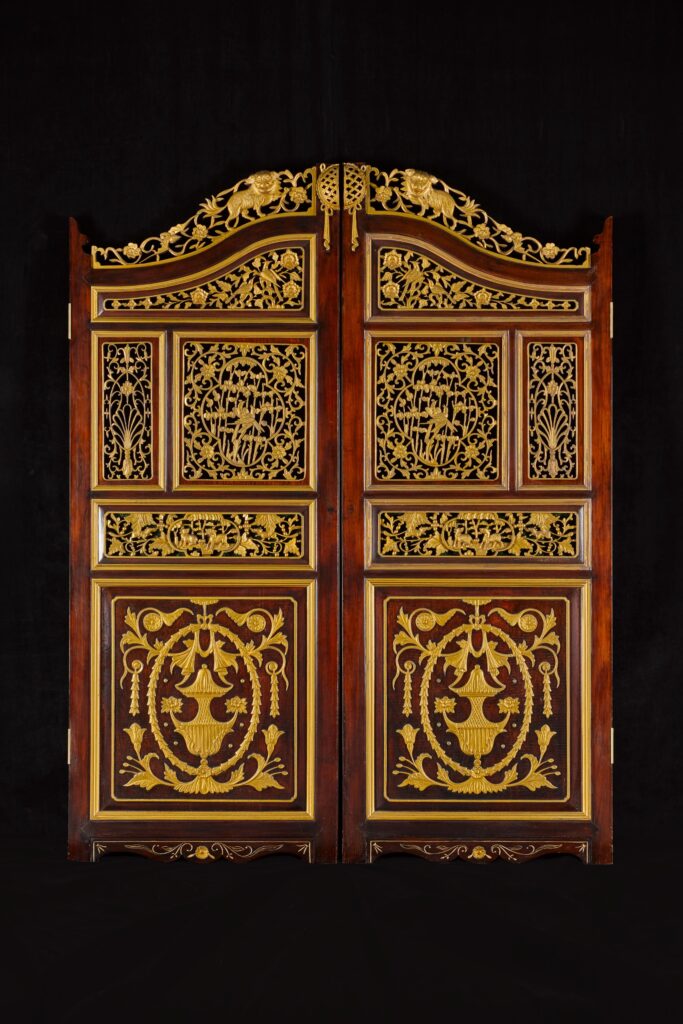
CO: A hallmark of the Peranakan aesthetic is most certainly its unique feature of hybridity.
A traditional Peranakan house is a long terrace dwelling with a front and back door and air-wells in between for light and ventilation. The pintu pagar (“fence door” in Baba Malay) is a half-height outer door that provides ventilation, security, and privacy when the front door is left open during the day.
This unusual pintu pagar is carved and gilded on both sides with an eclectic mix of Chinese and European motifs consisting of lions, flowers, squirrels, and vases. Most pintu pagar are carved on only one side. The curved top was a popular feature in Singapore. Finely carved pintu pagar served as symbols of wealth for Peranakan families, visible to all visitors.
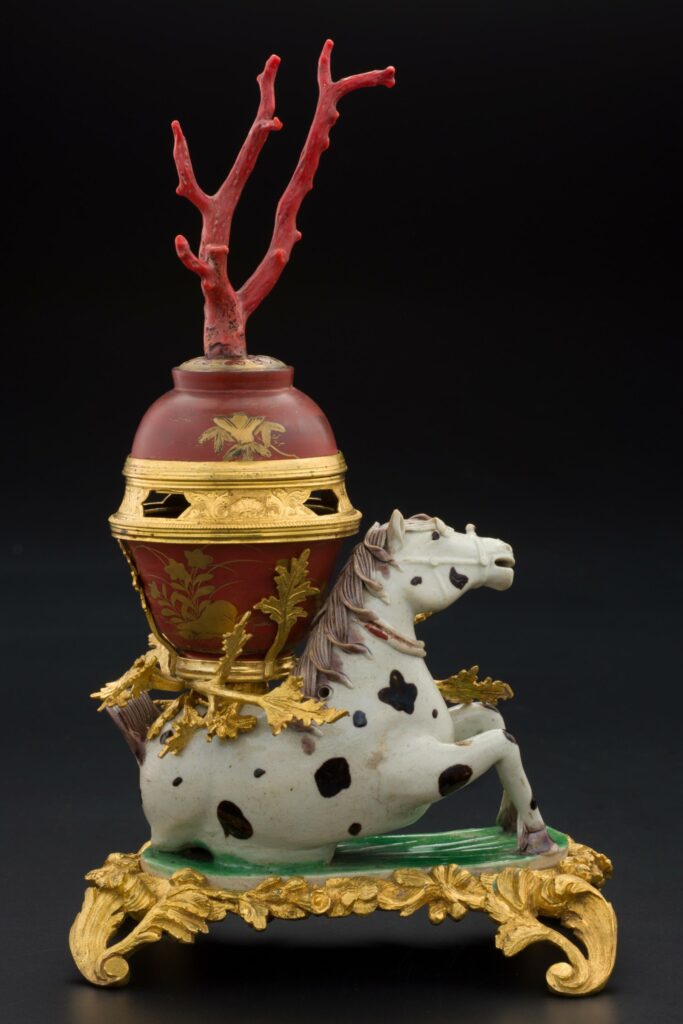
Mounted incense burner
Europe 18th century
Porcelain (China, Jingdezhen, around 1700), gilded bronze mounts (France, mid-18th century), lacquer bowls (Japan, 18th century), red coral
CO: This piece is perfect as an example of cross-cultural collaboration. As you can see, it has multiple components hailing from different places – China, France, Japan – artfully combined to create this exquisite object.
This incense burner was assembled in Europe during the eighteenth century from several components. The Chinese porcelain horse, made in the Kangxi reign (1662–1722), is realistically modelled on a green-glazed base that imitates grass. Above it are two Japanese lacquer bowls set rim to rim; inside them is a metal tray to hold burning incense that would escape through openings in the gilded ring connecting the bowls. Crowning the object is a piece of red coral. The pieces are held together by gilded bronze fittings made in Europe. Imaginative creations like this, which blend objects from different cultures and mix the natural with the man-made, were favoured in Europe in the Baroque and Rococo periods (17th and 18th centuries).
EL: Can you give us a teaser of any upcoming programmes and exhibitions?
CO: We have an exciting line-up of programmes and exhibitions this year.
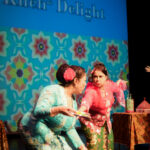
At Peranakan Museum, we have just concluded our annual Armenian Street Party in March, where our Peranakan communities came together and shared Peranakan culture and heritage with the public. The event was very well received, with delicious food, cooking demonstrations and exciting performances. This year’s edition included a significant partnership with Mediacorp, which promoted the newly-launched spin-off series Emerald Hill – The Little Nyonya Story with daily cast appearances and even a dedicated themed activity space. Community activities throughout the weekend included Peranakan makeovers by esteemed kebaya maker and Steward of Intangible Cultural Heritage Raymond Wong; and In the Mood for Kebaya, a fashion show featuring models from The Peranakan Association Singapore (TPAS), Peranakan Indian (Chitty Melaka) Association Singapore (PIA), Gunong Sayang Association, with special appearances by the cast of Emerald Hill; and even a special performance by Dick Lee. The positive response from this festival underscores the increased awareness and increasing public interest in Peranakan culture. We will also be continuing our Community Voices series throughout the year, where we showcase diverse Peranakan communities as they present their unique culture and traditions through community-led activities such as performances, demonstrations, workshops, and tours.
Further on in October, we will also be presenting our next exhibition which will showcase the peacock as a popular and enduring motif across cultures, widely appreciated and adopted not only in Peranakan art but also in the religious and secular cultures of Southeast Asia, India, China, and Japan, which influenced depictions in Western artistic traditions.
Over at ACM, we will have an exhibition Let’s Play! The Art & Design of Asian Games (working title) opening in November this year. Do you recall the communal tables with black-and-white chessboard, which are a familiar sight at HDB blocks in Singapore? This exhibition will invite visitors to trace the rich history of Asian boardgames and the powerful role they play in fostering community, creativity, and critical thinking. Through interactive exhibits and intricate examples of games like go, chess, mahjong, and congkak, the exhibition explores the interplay between strategy, luck, and skill to reveal how games form a significant part of our shared cultural heritage.
As part of our periodic gallery refreshes, we will launch Elegant Sounds: Music, Craft and the Literati, which will be a two-year multisensory exhibition for the Scholars Gallery that uses the guqin (Chinese zither) as an entry point to examine literati art and culture. The exhibition delves into the history, symbolism, and artistry of the guqin through a diverse array of objects, including ancient instruments, bronzes, paintings, ceramics, rare books, and furniture.
Photo credits: Asian Civilisations Museum; Peranakan Museum