 Noreen Chan
Nyonya Noreen Chan delves into her Mama Elsie’s precious and diverse range of recipes.
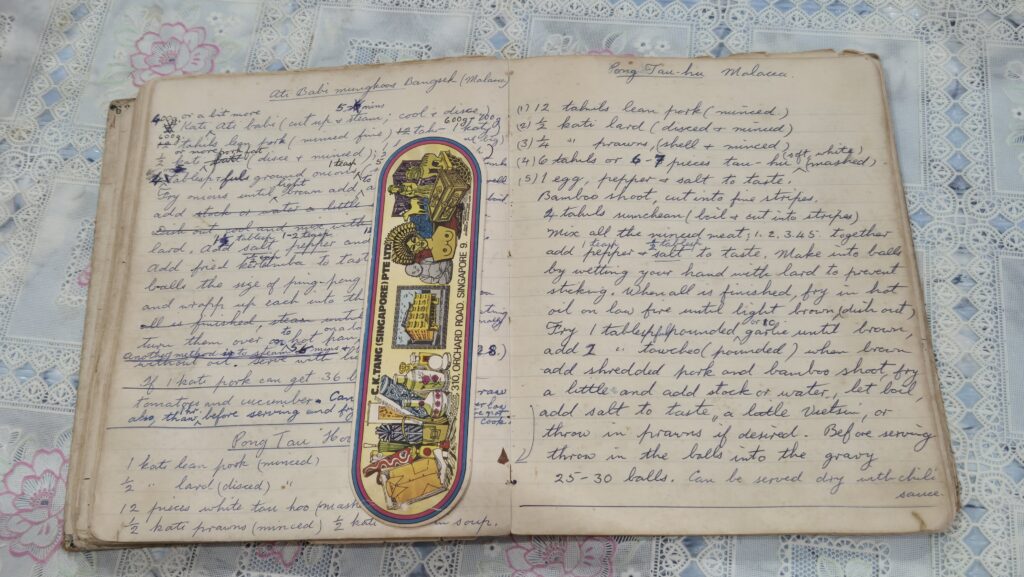
Growing up, there were two main cooks in the family – our Cantonese “black-and-white” amah Ah Kan, who cooked the laok hari hari (daily dishes), and my Mama Elsie, who oversaw the Peranakan festive dishes – like hati babi bungkus, popiah and achar – and the kueh and cakes.
Ah Kan had come to work for my parents when they got married, and her previous employer, one of my grandaunts, had taught her how to cook a wide range of dishes, ranging from Peranakan favourites to Cantonese specialities, to even Western-inspired pork chops and chicken cutlets. I never saw her refer to any notes and always wondered how she could remember everything.
Mama, on the other hand, wrote her recipes down in neat, flowing, cursive handwriting. When she was in her 80s and recovering from surgery, she transcribed her collection into a new book, arranging the recipes into categories of meat, poultry, vegetable dishes and so on.
The older recipes had no quantities, just a narrative in Baba Malay on how to cook the dish – just like how you might describe it to a friend who asked. In the new book, she not only translated many of the instructions, but added notes and some suggested quantities of various ingredients. That said, many of the suggestions were quite vague, like “handful”, “thumb-size”, “goli” (marble) or cost (10 cents).

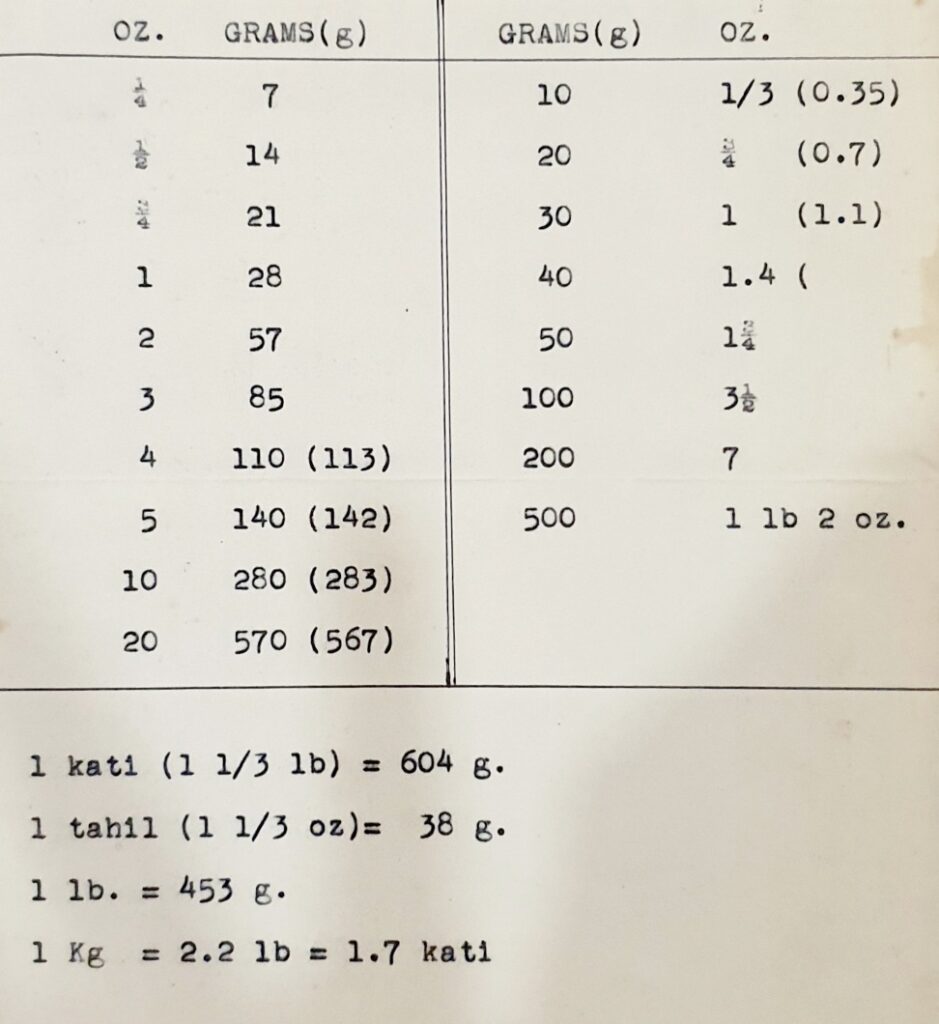
Mama’s self-made conversion table.
She took care to acknowledge the source of the recipe, whether it was a relative, friend or even magazine or TV. There were comments like “V.G.” (very good) and the frequently used recipes had the most annotations, including quantities for when we were making 2 or 3 times the recipe amount. Later, she even had a typed out table to convert katis, tahils and pounds into metric.
There are dishes that she was introduced to after her marriage, when she moved to Melaka. So we have bludder – a Dutch inspired yeasted bread flavoured with toddy and enriched with butter, lard and fifty (yes, fifty) egg yolks, and itek hoong, which used leftover “bee chio” (the “flour sauce” for popiah) as an ingredient.
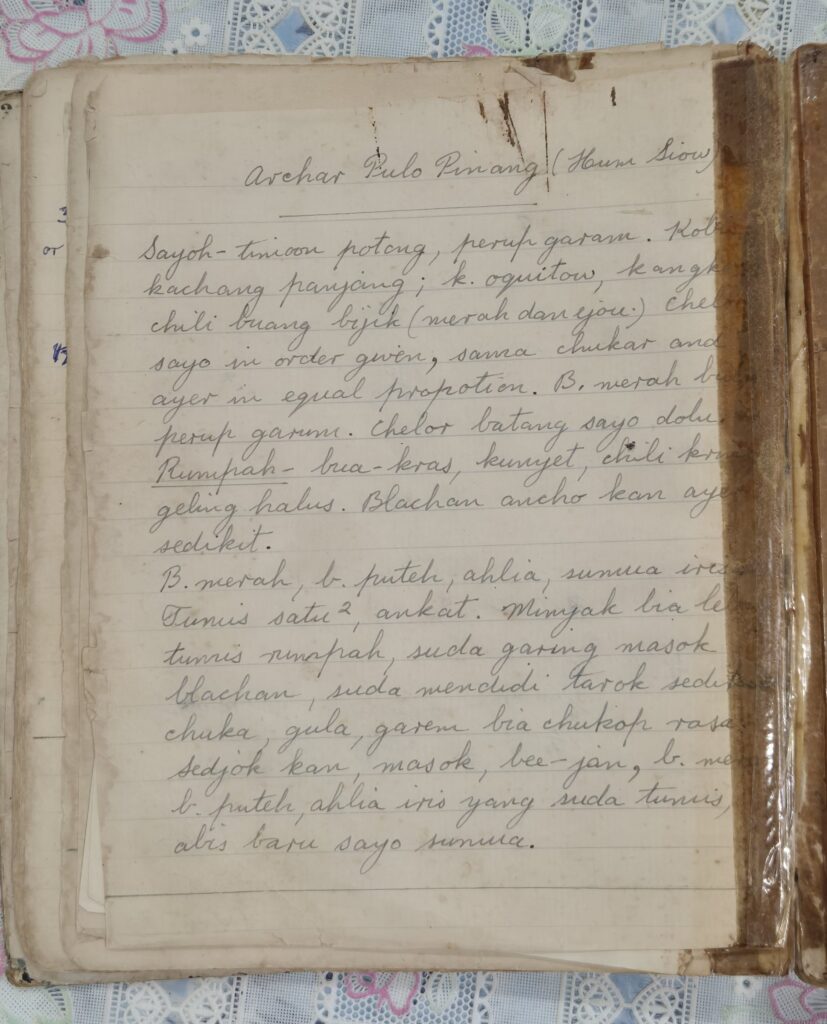
Recipe for “Archar Pulo Pinang” by Hum Siow.
There is “Archar Pulo Pinang” (Penang style Achar) from “Hum Siow”, who came into our extended family as a bondsmaid, but eventually was accepted as a relative; in fact I knew her as Poh Cho Hum. She was given the name Hum Siow after the flower (likely the Magnolia figo or Banana shrub). To this day, our preferred version of achar is the Penang variety, but the recipe we use is from my Tua Kim Poh.
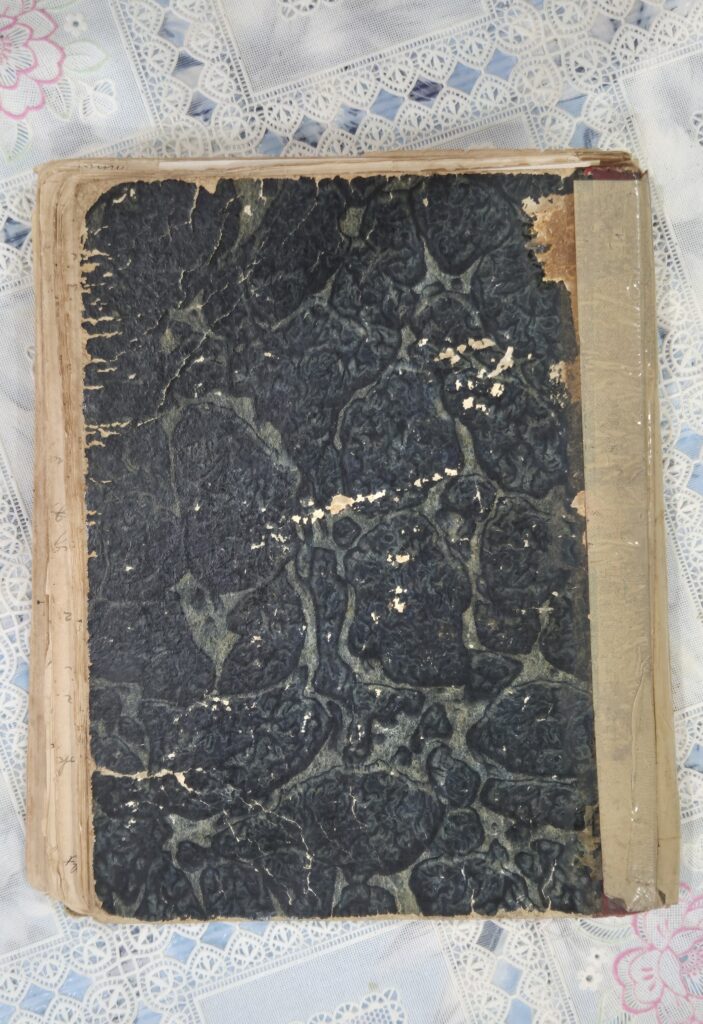
Mama Elsie’s old recipe book, which was featured in the “Junk to Jewels” exhibition at the Peranakan Museum.
Some of the recipes cannot be made today because the ingredients cannot be obtained in Singapore e.g., assam sinting, a relish made from a shellfish that used to be gathered at low tide. But I find it fascinating anyway, because the ingredients we use, the food we cook and eat, tells us a lot about ourselves. Flipping through the book is a journey back through time and Mama’s life, the people she knew and the food she cooked (or was interested in cooking), and I never tire of it.