 Dr Jin Teong Ong
Baba Ong Jin Teong takes us on a delicious journey through time, culture, and the crunchy magic of koay pai ti.
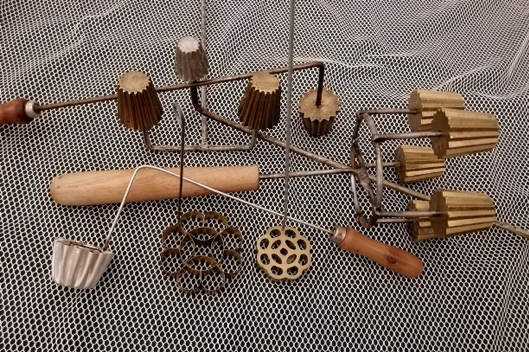
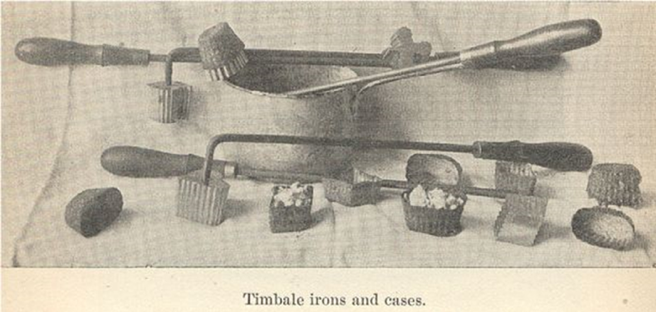
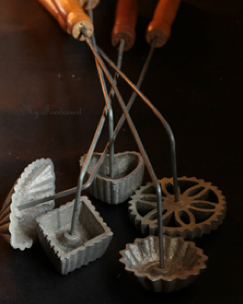
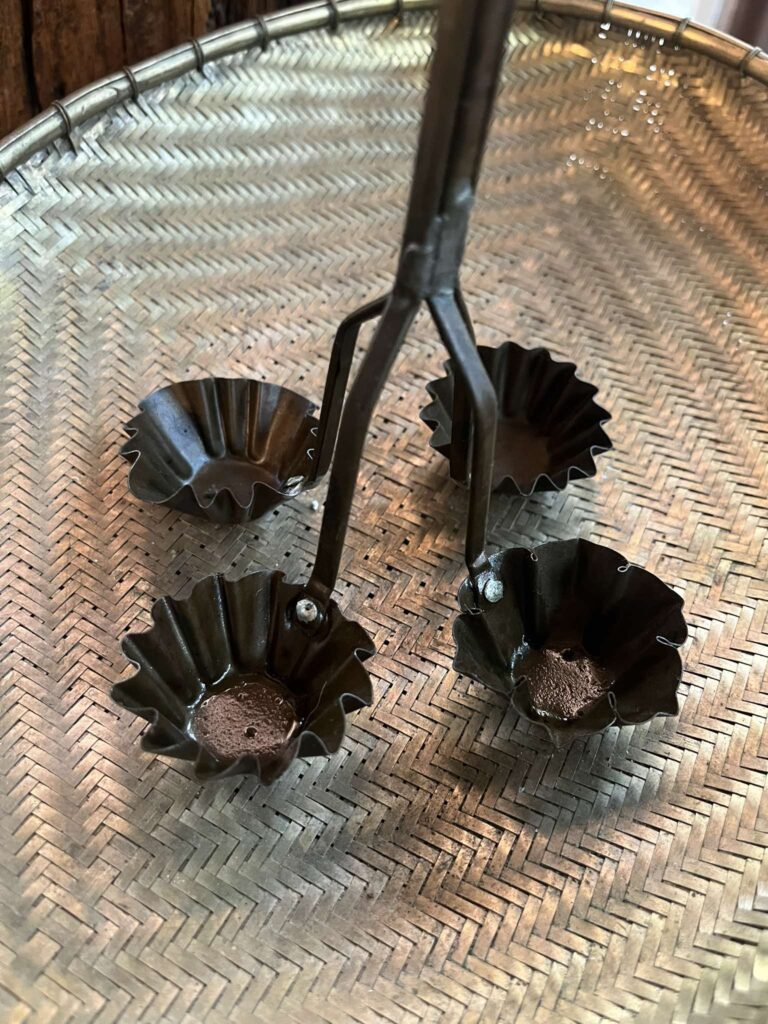
You may wonder how koay pai ti and kuih loyang are related. I certainly did not—until I began researching the origins of the koay pai ti mould. My exploration led me to the Scandinavian timbales and their counterpart, the rosette. Scandinavian emigrants likely brought timbale and rosette irons to the United States, where they were manufactured and sold under brand names such as Griswold, Hirco, and Norwegian Wares. Traditionally made of iron and known in the U.S. as “patty irons,” these moulds evolved over time to lighter versions made of cast aluminium alloy. Similar variants, such as the Thai Krathong Thong and Khanom Dok Chok moulds, are fashioned from brass or aluminium sheets.
Timbales and Rosettes
Both timbale and rosette irons typically feature long handles screwed onto interchangeable moulds. Timbale moulds—also known as patty shell moulds in America—come in fluted or plain varieties and a wide range of shapes: round, square, diamond, seashell, heart. The name “timbale” originates from the French word for drum and refers to a crust or shell used to hold sweet or savoury fillings. These shells are created by dipping a hot mould into batter and deep-frying it. Rosettes, made using similar batter, are fritters traditionally dusted with icing sugar and shaped in decorative designs such as stars, butterflies, and snowflakes. Solid metal was used in older models, some of which feature dual handles for making two rosettes at once.
Transcultural Evolution
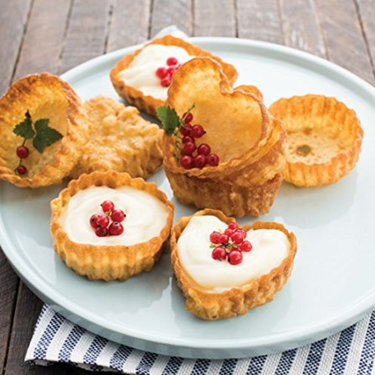
Patty irons, timbale moulds, and rosette moulds are used much like koay pai ti moulds: to create crisp edible cases filled with savoury or sweet fillings. These recipes featured prominently in Swedish-American cookbooks until the late 1930s.I recently acquired a vintage rosette patty iron from the Western Importing Company (New York, Minneapolis, Montreal) via eBay. The moulds are significantly larger than our traditional koay pai ti versions—fitting, as they were designed to hold more filling.
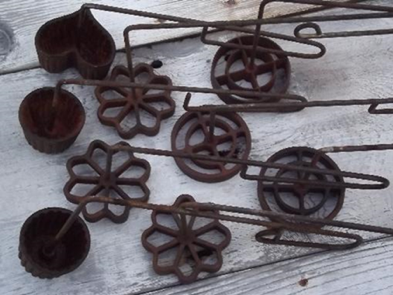

Koay Pai Ti / Kuih Jambang / Jawa Kwei Pattie
Our beloved koay pai ti most likely has roots in the Swedish timbale. Whether it arrived via American missionaries or European colonisers remains uncertain. Variants of koay pai ti are found across Singapore, Malaysia, Indonesia, and Thailand.

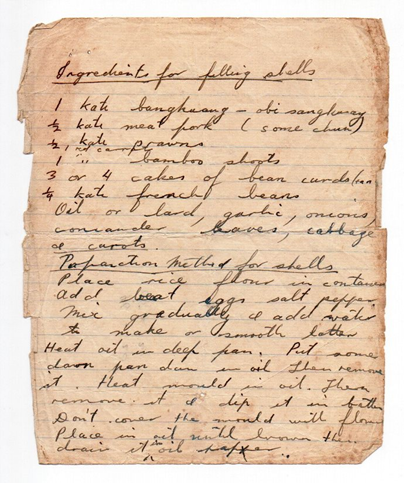
One of the earliest documented recipes appears in the 1932 edition of the YWCA International Malaya Cookery Book. It mentions the use of a “pattie iron” and describes a filling of vegetables in a rich sauce—using ingredients very similar to timbale batters: egg, milk, wheat flour, and sugar. My mother’s recipe, however, replaced milk and sugar with ground rice, tapioca or cornflour, slaked lime (kapur), and ground pepper.
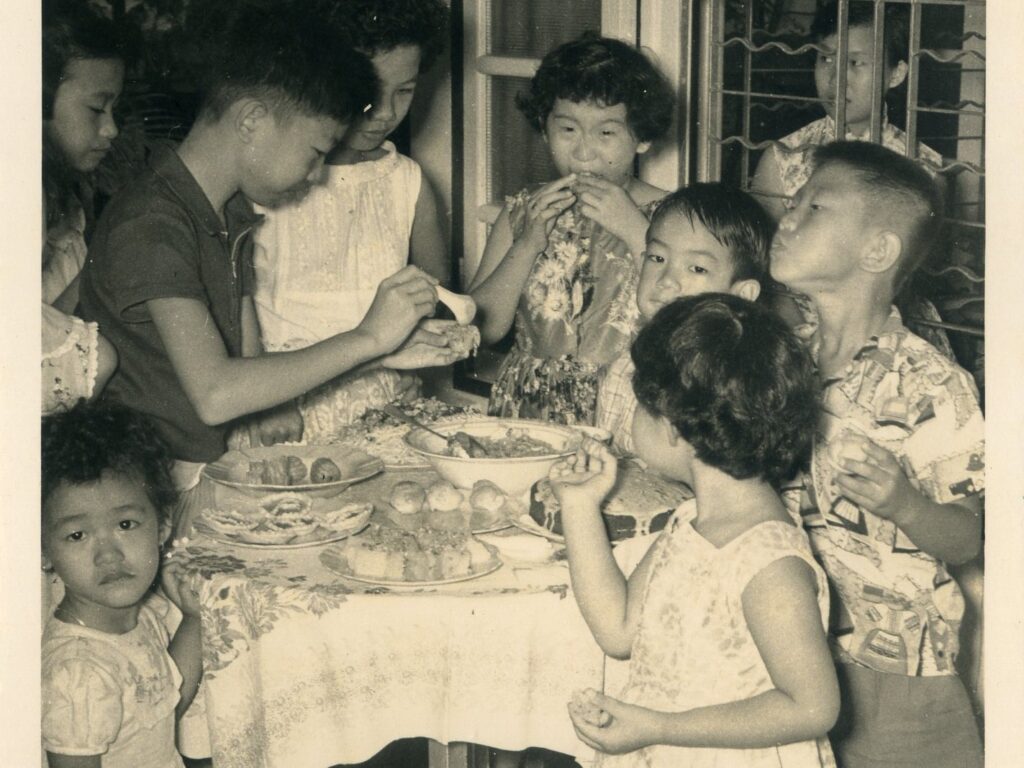
Koay pai ti was a staple at birthday parties in our home, always made by my mother. She conducted cooking demonstrations in Penang for the YWCA and the MGS Ex-Pupils Association. Since pai ti moulds weren’t commercially available then, my father commissioned a blacksmith to make pai ti moulds for all the early participants who attended my mother’s cooking demonstration.
Unlike poh piah, the filling in my mother’s pai ti is dry and finely sliced—preserving the crispness of the shell. I’ve noticed that some modern interpretations use coarse fillings that overwhelm the delicate shell. In Penang, even prawns are diced and folded in, avoiding the ostentation of whole garnishes.
Regional Adaptations
A 1990 article in Pulau Pinang magazine recounts how the term “Shineto Pie” emerged from a post-WWII function in Singapore, where guests were introduced to the dish. “Shineto” reflects the Japanese wartime pronunciation of Singapore. The article also notes early handmade copper moulds.
Ellice Handy’s 1952 book My Favourite Recipes includes a “Pie Tee” recipe resembling Malayan poh piah, though ingredients like tau cheow (now rare in Penang versions) were used.
Our Aunty Jane would use “min chee”—a Hainanese Nonya dish—as pai ti filling. Susie Hing’s In a Malayan Kitchen (1956) features a Java dish, Kroket Tjanker, whose name likely stems from the Indonesian “cangkir” (cup). In Malacca and Singapore, Babas use “changkay” similarly. The name “kuih jambang”—Malay for floral container—aptly mirrors the timbale’s shape.
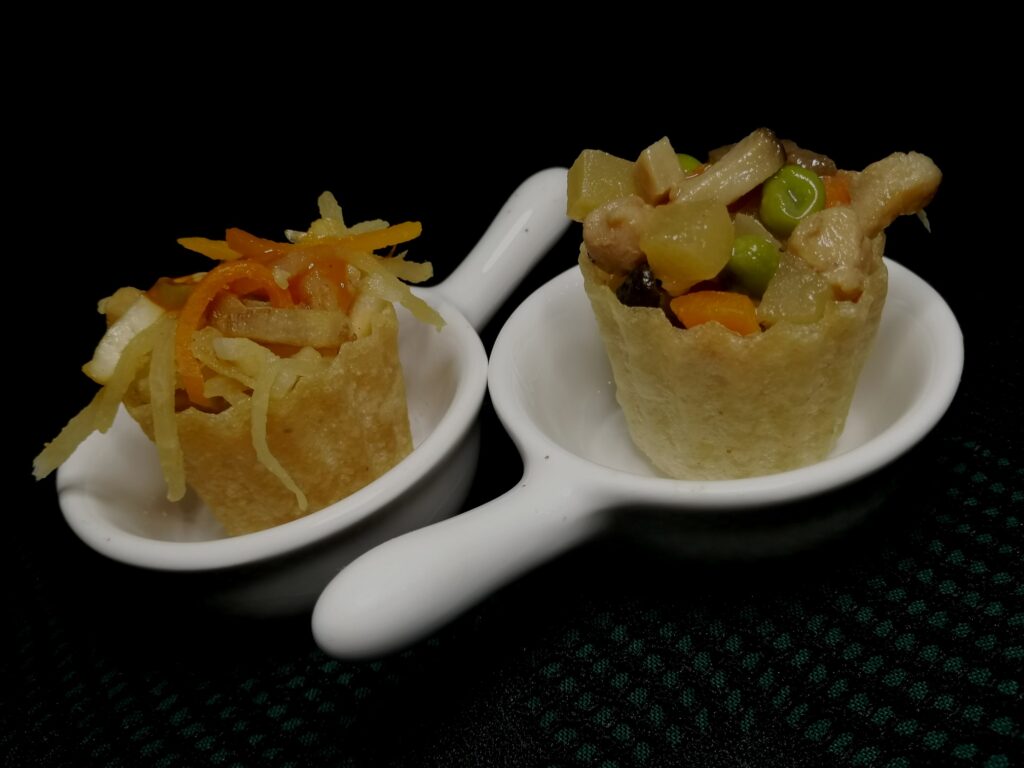
In Thailand, the Krathong Thong (“golden cup”) resembles pai ti in form and function. Lighter, sheet-metal moulds are used—unlike the solid brass moulds from Penang. While some sources describe brass moulds as “modern,” I believe they predate the Thai versions.
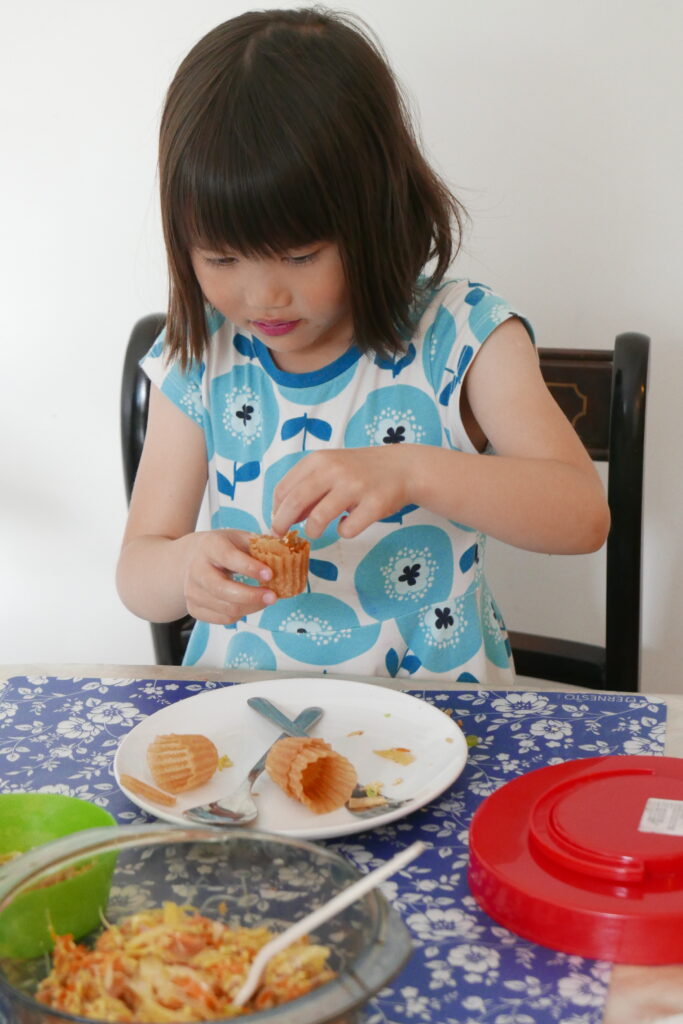
Making the Shells
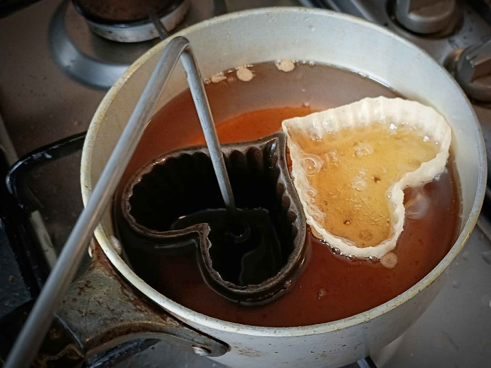
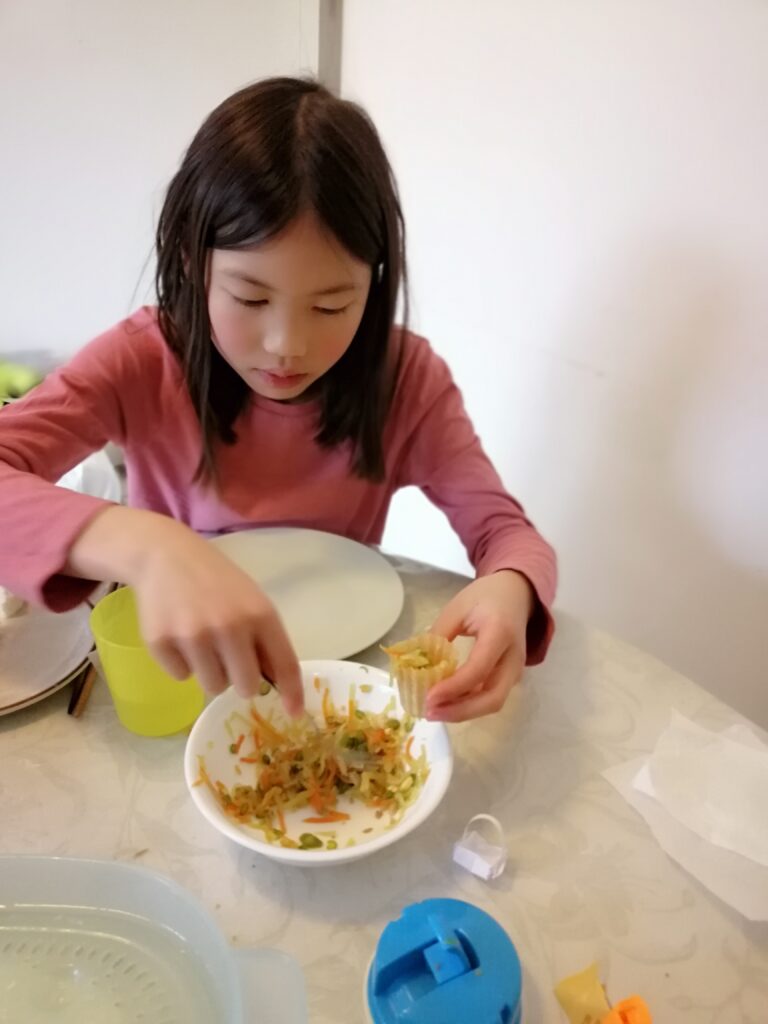
To make a pai ti shell, a heated brass mould is dipped in batter, then deep-fried. By adjusting the movement in oil—such as lifting and dipping—the shell can form into a “top hat” shape. If removed too early, the shell folds in like a clam.
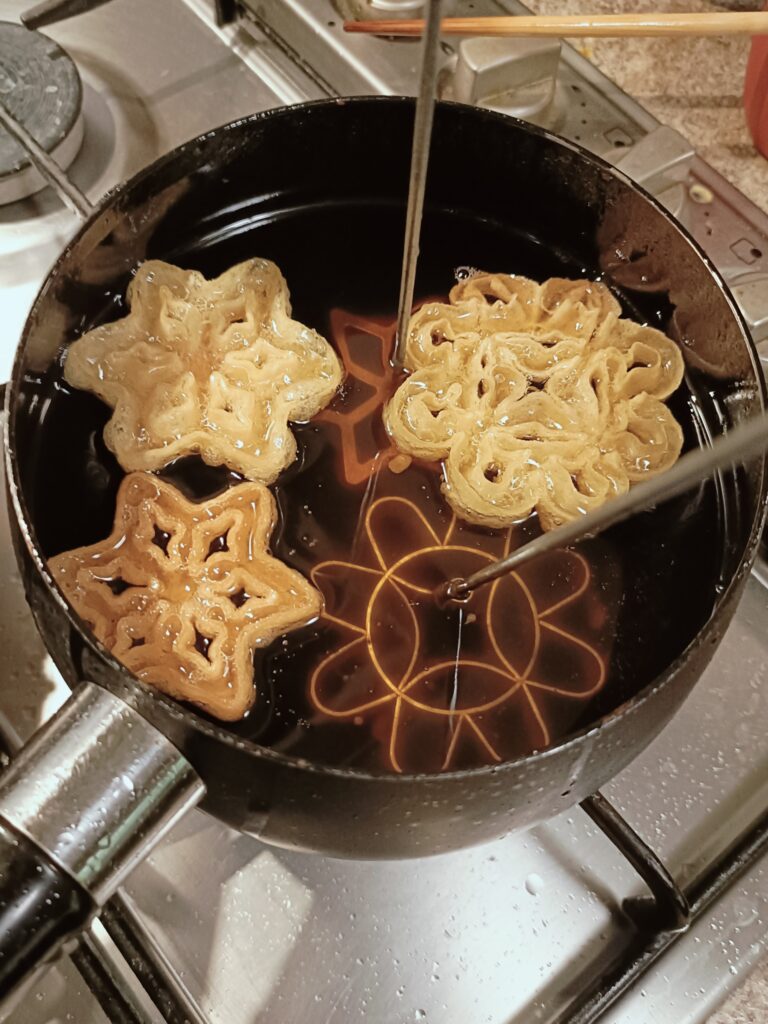
Rosette fritters (kuih loyang, kuih goyang, or kuih rose) follow a similar process. Their name in Malay reflects either the material (loyang = brass) or the technique (goyang = shake). Variants of rosette fritters appear globally—in Europe, South America, the Middle East, and across Asia—often adapted with local flours, coconut milk, lime, sesame seeds, and spices.
To enhance kuih rose visually, place the hot fritters on an inverted bowl to shape them into three-dimensional blooms.
Tips for Perfecting Pai Ti and Kuih Rose
Success depends on three variables: oil temperature (ideally 170–180°C), batter thickness, and mould immersion time. Stir the batter regularly and jiggle the mould in the oil to ease detachment and create elegant top-hat shapes.
If using Thai-style moulds (thinner and more conductive), pay extra attention to maintaining the mould’s heat.
Possible Origin Paths
While it is likely that pai ti moulds evolved from Scandinavian timbales, the exact route is unclear. Was it via American missionaries and cookbooks? Dutch colonials? Or even Portuguese traders who influenced Thai culinary practices?
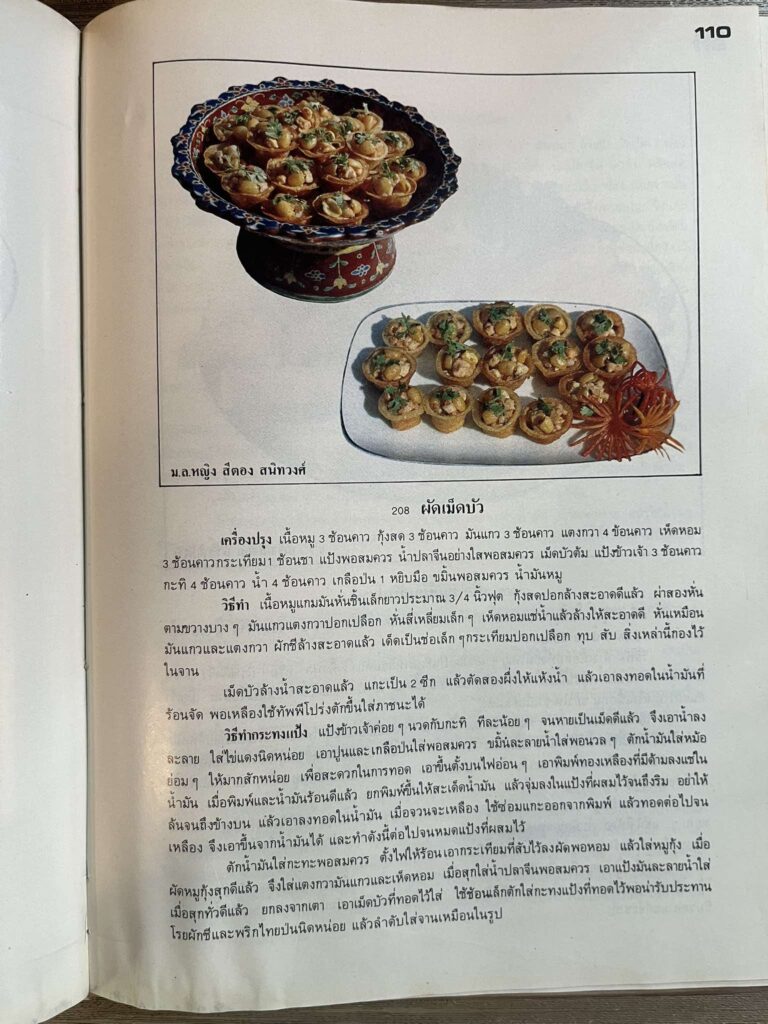
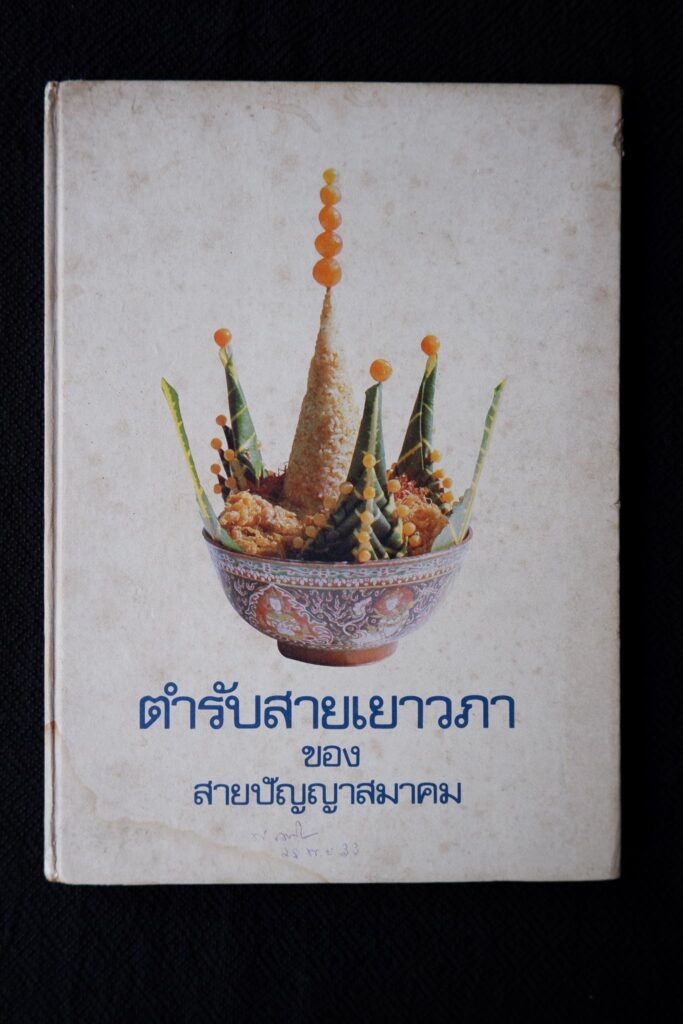
New evidence from a Thai Facebook post by Chantrarat Hemawet suggests that Krathong Thong was inspired by a Penang dish served to King Rama V during his visit. Officials brought the moulds back to Thailand, adapting both filling and mould for local tastes. A 1935 Thai cookbook, Yaowapha Recipes, attributed to Princess Yaowapha Phongsanit, includes early recipes for both Krathong Thong and Dok Chok (kuih rose).
Conclusion
This has been a meaningful personal journey—tracing the roots of a dish from my childhood to its possible global ancestry. While the exact origin may remain elusive, the stories we uncover along the way only deepen our appreciation. Chris Tan’s recent article in BiblioAsia, Cups and Sources: Hunting Down the Origins of Kueh Pie Tee, explores similar themes. We are, perhaps, telling the same story through different eyes—and that, in itself, is a tradition worth celebrating.
© Dr Ong Jin Teong, 2024
OJT/PaiTiKRose/TimbalesRosette/March24/17-1-25