Anne Tan
Nyonya Anne Tan examines the auspicious motifs on her father-in-law’s collection of Peranakan porcelain
The Comprador Lineage
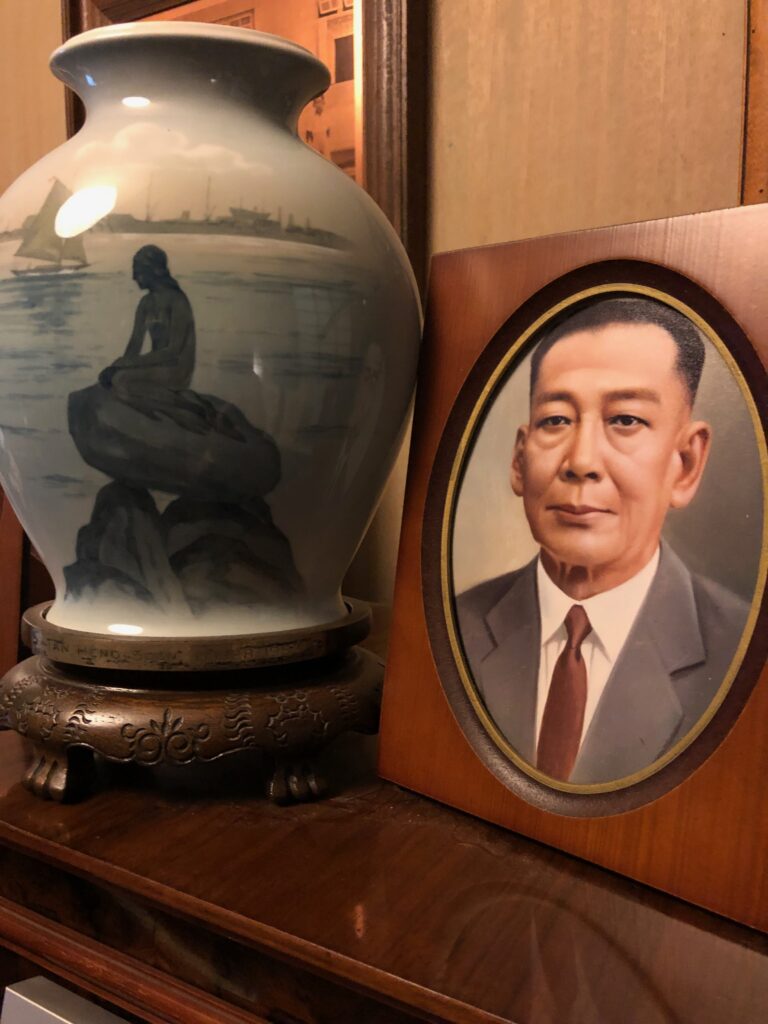
Sitting on my piano is a Royal Copenhagen vase depicting Hans Christian Andersen’s Little Mermaid. The vase was presented to my late father-in-law, a prominent Penang Baba comprador with the historic Danish giant East Asiatic Company (EAC). Also in my treasured keeping is a collection of Nyonya ware which belonged to my late husband and his mother. Seemingly disparate artifacts, the story they reveal spans both the colonial corporate world and the domestic Penang Baba world.
A comprador (from the Portuguese word for ‘buyer’) fulfilled the role of critical agent in colonial enterprise. In entrepots like Penang these cosmopolitan bicultural middlemen were relied upon by Western merchants in conducting business.
Left: A Royal Copenhagen vase featuring the Little Mermaid accompanies a portrait of the author’s late father-in-law

The immense wealth generated by concessions in the Siamese teak logging industry (EAC being one of the licensed foreign-owned companies) is exactly what allowed elite families to commission premium hand-painted porcelain wares from Chinese kilns. Resplendent in vibrant colours and auspicious symbols, they held a special place in my husband’s cultural memory.
This family can be seen as a microcosm of that hybridity known as Peranakan, where my husband fondly remembered ‘there was always Carlsberg in the house’. Indeed, the EAC were the sole importers of Denmark’s Carlsberg beer. (Pinang Gazette and Straits Chronicle, 12 June 1934).¹
To the researcher examining these objects swamped as they are with auspicious symbols it feels akin to reading a text, uncovering the archaeology of the object to unlock the stories contained within.
- In May, 2024 issue Penang Monthly I explored aspects of this Penang comprador, his family and his role.
The Phoenix and Peony
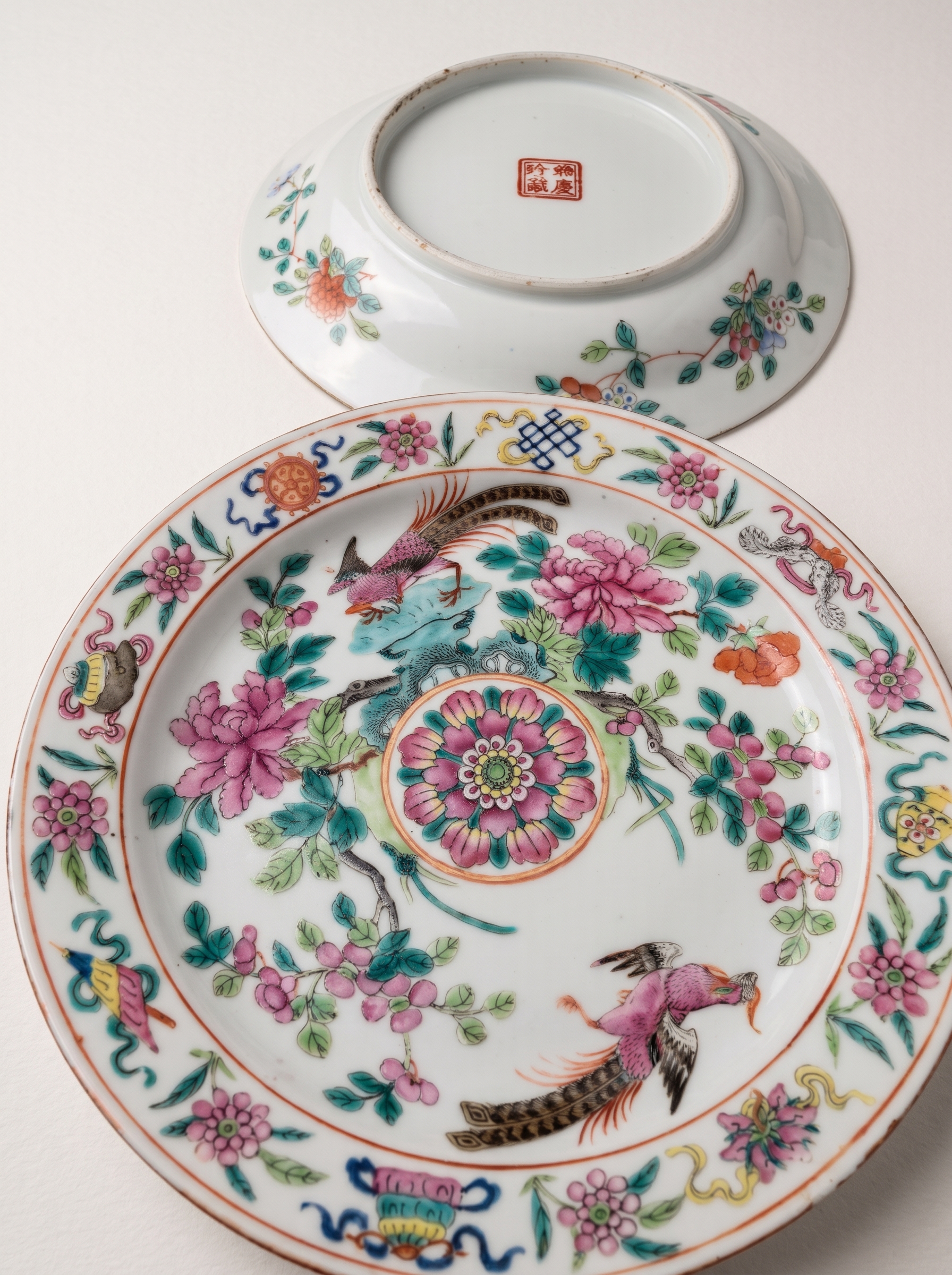
Peranakan porcelain (Nyonya ware) was produced for the Straits Settlements Chinese community, c.1800s to mid 1900s and traded by Chinese middlemen dealing in tin and rubber. Commissioned primarily for ancestor worship, weddings and ceremonial occasions, these material culture/objects/commodities were decorated with enamel colours of vibrant and passionate hue. Plates, bowls, spoons and spoon rests make up the collection I treasure. Chief among the motifs is the phoenix and the peony, a single decorative theme which characterises this amazing variety of artifacts. Bowls with scalloped rims, plates packed with jewelled enamel textures, ogival shaped spoon rests all display hand-painted phoenixes and lush peonies. The phoenix represents supreme beauty and grace and is usually associated with the female principle or yin. Signifying auspiciousness, the five colours of its feathers stand for the five cardinal virtues of righteousness, propriety, wisdom, humanity and sincerity. Most frequently paired with the phoenix is the lush peony, esteemed for its large pink and red ruffled blossoms. Signifying prosperity, it is emblematic of wealth and distinction. Peranakan brides are referred to as an “empress for a day” with wedding ceremonies being ornate, lavish and regal. Often, their beaded slippers feature the peony rose.
With so much of Nyonya ware destined for weddings and festive occasions, the pairing of phoenix the ‘Emperor of the birds’ and peony the ‘Queen of the flowers’ presents as culturally significant, a wish for peace, harmony and prosperity.
Eight Buddhist Emblems
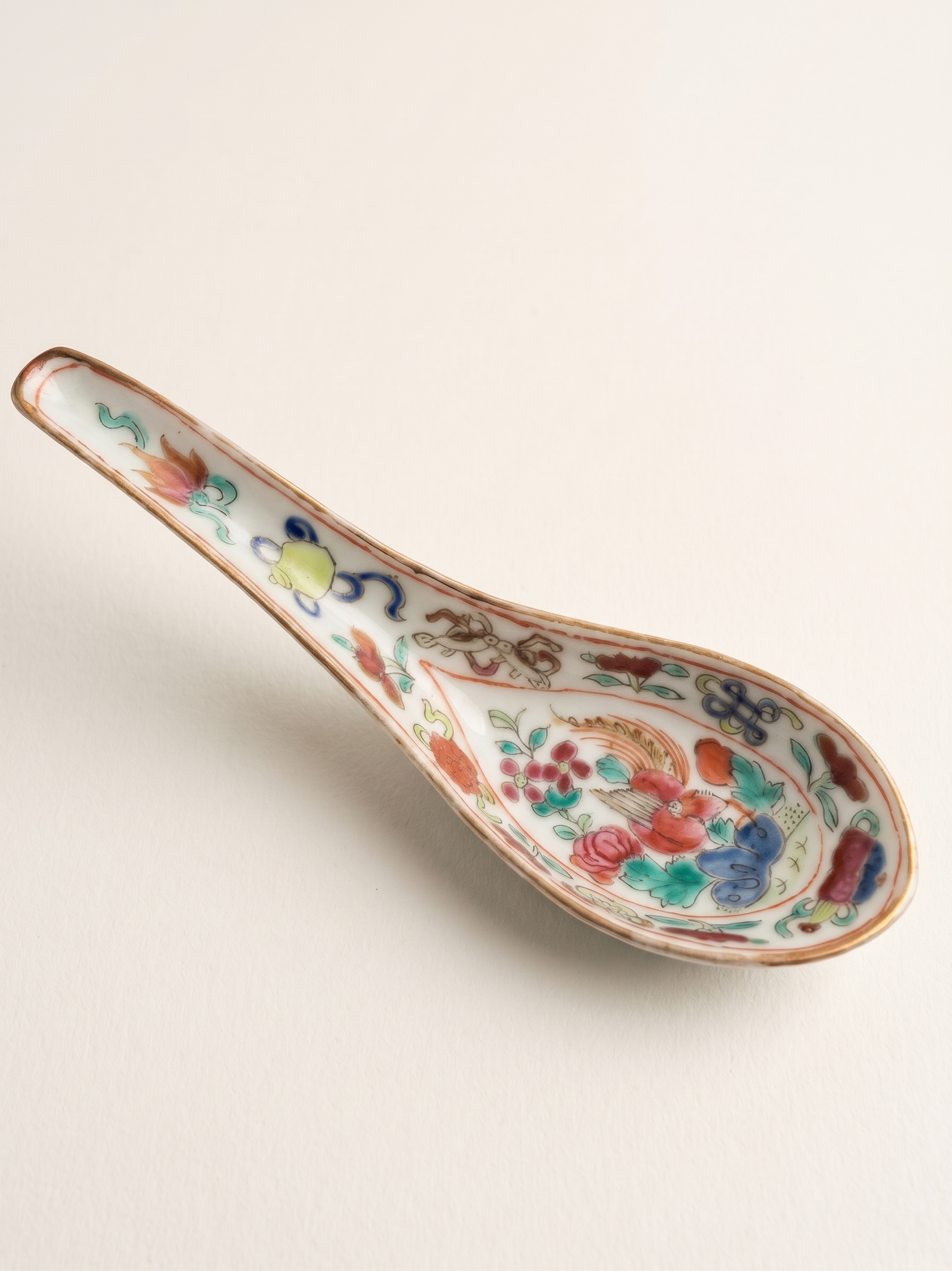
Next- a move to an in-depth look at the single most important border decoration on Nyonya ware, the iconographies of the Eight Buddhist Emblems or Bajixiang which are auspicious signs found on the sole of the Buddha’s foot. The eight emblems comprise the Wheel of Law, represented by a flaming wheel, a symbol of Buddha’s teaching of the path that leads to enlightenment; a conch shell, an emblem of Buddha’s call to his disciples to follow his precepts; an umbrella, a protective shield from evil and disease; a banner or canopy, signifying victory over evil; a lotus flower, representing purity triumphing over the murkiness of life; a vase, a repository for treasures; a pair of fish, representing marital bliss and fidelity; and an endless knot, a symbol for eternity. These emblems are used in combination with floral sprays and energetic trailing ribbons. Nyonya ware artifacts are everything, everywhere, all at once! With an aesthetic of packed colour and bright jewelled refinement these porcelain objects are swamped with symbols of longevity, fortune and health. The highly structured designs tied Peranakans firmly to their Chinese heritage.
Some Reflections
In summation, Nyonya ceramics represent a vibrant intersection of material culture and global trade. Custom commissioned by the wealthy Straits Chinese communities, their tastes and instructions for design and colour communicated by merchant traders to potters in China. Formerly, the gaze on these objects has focused on design, colours, etc., whereas we see the scholarly gaze now turning its focus on material culture and trade. Each object/commodity/artifact has a lifespan, a ’biography’ (e.g., Who made it? Who owned it? Where did it go over time? How was it used? How does the thing’s use change with its age?). Porcelain objects are objects with global lives, the layers of meaning that objects accumulate as they move through stages of production, ownership, transmission and transformation. Material culture history requires an interdisciplinary approach drawing on insights from art history, archaeology/anthropology, literary studies and historical studies, especially global history. It will be interesting to see what emerges.
Anne Tan is a retired academic ( Deakin, Melbourne) and independent researcher. She lectured in the Arts Faculty and her areas of studies include English, History and Interdisciplinary Studies. Her book The Emerald Kingdom: A French Lens on the Teak Frontier details the teak explorations of the Danish East Asiatic Company in Siam and Laos with particular reference to a newly discovered company photo album. Her research into the colonial corporate world on a Peranakan comprador and Nyonya porcelain has been published in ScandAsia and Penang Monthly. Her grandfather’s Boer War service appears in Colonial Volunteer: Soldier of the Queen.