 Emeric Lau
In conjunction with TPAS’ 125th anniversary, Baba Emeric Lau takes an editorial perspective
in tracing the evolution of The Peranakan magazine
In all honesty, I will state upfront that this has not been the easiest of articles to write. When our Head of Communications, Nyonya Theresa Tan requested that The Peranakan publish a feature on the magazine’s history, it sparked a spell of reflection on how our humble publication has evolved.
Reflection
Longtime readers may recall – or wish to retrieve and re-read from their own hard copy stash – then-editor Nyonya Linda Chee’s article, Team Tulis in Issue 1, 2014, where we featured members of the editorial committee through the years. Some vignettes stand out: how Co-Founding Editor Baba Peter Lee would spend hours on Baba Ian Yap’s first-generation Macintosh “writing, designing and printing the newsletter by himself”; the delight experienced by another Founding Member, Nyonya Helen Tan, at seeing a photo in the magazine of a dashing young Lee Kuan Yew serving as secretary of the Straits Chinese British Association; and Wee Eng Hwa’s recollection of her father, Dr Wee Kim Wee, Singapore’s first Peranakan President and a former Deputy Editor of The Straits Times, supporting the idea of TPAS having a magazine to connect Peranakans.
Indeed, like TPAS, our magazine has a rich history and continues to adapt to changing paradigms, from a four-page photocopied newsletter (1994) that informed members of association activities to a 40-page quarterly publication (circa 2005) that documented the culture, and then to a twice-yearly award-winning magazine (2014), an online e-zine (2023) and now sporting a revamped online format (2025) – it has been quite a ride!

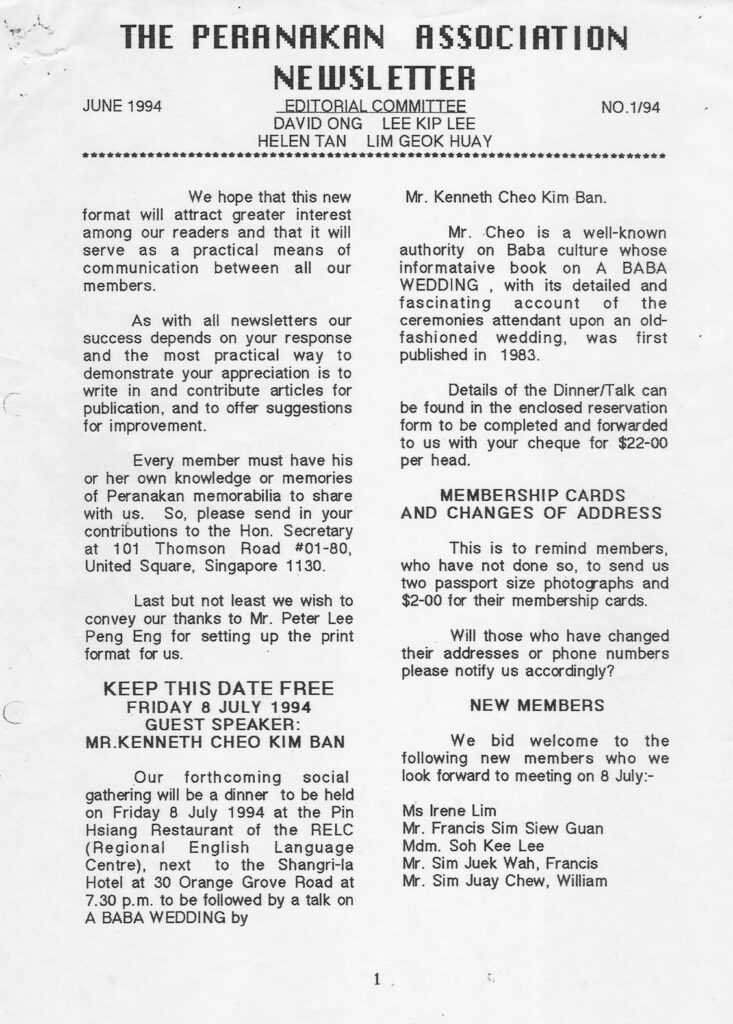
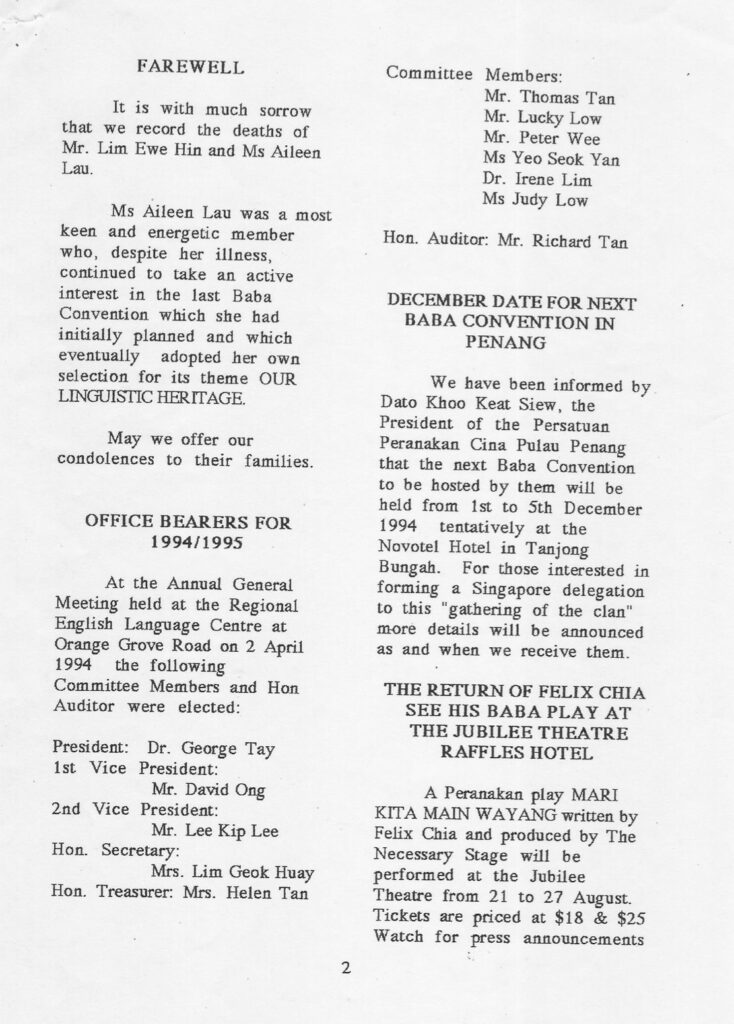
Quoting from A Culture of Interconnections by Baba Peter Lee, published in Issue 1, 2019, the very first sentence of the first newsletter in June 1994 still holds true for the revamped online magazine: “We hope this new format will attract greater interest among our readers and that it will serve as a practical means of communication between all our members.”
Respect
I joined the editorial committee in 2006, and have served as Assistant Editor under Linda Chee, Dawn Marie Lee, and Bryan Tan. I have found in them cherished friends and respected confidantes. We are connected by a shared passion for our culture and heritage.
Putting the magazine together is a true labour of love. We could not have done this without the support of so many past and present editorial committee members, contributors, advertisers, and of course, our dear readers: thank you for staying with us!
I am particularly grateful to Editorial Adviser John Lee and Designer Joanne Low for seeing our revamp through, and I look forward to working with Eunice Yap, who has kindly taken on the role of Editorial Secretariat, helping me with administrative and logistical matters.
I would be remiss to avoid addressing the sensitive subject of taking the magazine online. TPAS’ immediate past President, Colin Chee, sought many opinions on this matter, and I shared with him that our members looked forward to receiving the hard copy, yet I also believed that there were great benefits from going digital. Colin carefully weighed the merits of going online against the strain on resources (both financial and otherwise) that continuing to print and distribute the magazine entailed, notwithstanding the fact that most editorial committee members contribute their time and effort pro bono. Ultimately, the decision to go online was made. I remain open to having a printed magazine, provided a sustainable model for operation can be derived.
Relevance
My own journey with TPAS has been something of an anomaly. At the “ripe old age” of 25, I joined TPAS and then became a member of the general committee around 2004 – 2005, at the recommendation of Baba Alan Koh; and I’m now on the brink of my third decade with the magazine! All this despite being a relatively young 46. It is an interesting position – senior by some measures, yet a junior by others. This means that I’m always trying to strike a balance between advocating for the needs of Peranakan youth, while understanding the perspective of old guard voices. I often find myself having to calibrate my actions to suit different contexts – an ability that is really an essential part of being Peranakan – but the fact is that the future ultimately lies with our youth.
Speaking of the next generation, I feel uplifted through conversations I’ve had with TPAS’ younger members, and am heartened to have an ongoing engagement with Baba Gabra, an enterprising team of four young Babas.
Singapore ranks No. 3 in the Gensler City Pulse 2025 report of the top 10 magnetic cities where newcomers and residents feel they are most likely to stay (Straits Times, Life! June 20). Significantly, success belongs to urban centres that are designed not just for growth, but for genuine human connection: “the intangible threads of pride, belonging and community spirit are what engender a sense of belonging to a place – transforming a city from a destination into a home.” A home is where one feels a “deep emotional connection”. Indeed, the Peranakan community has helped Singapore create an inclusive society where we welcome people of all ranks, religions, and races. In that vein, The Peranakan magazine will continue to focus on our humanistic values to draw people together.
Going forward, the magazine will work in tandem with TPAS’ various communication platforms: Facebook, Instagram, and YouTube, empowering swifter and higher levels of engagement with more frequent content publishing and dissemination. Embracing multiple digital channels means we’re staying relevant by actively and efficiently promoting our culture amongst our members, across the region, and indeed to audiences the world over. Outward and Onward!